Key Takeaways
- Solar panel leasing vs buying in Thousand Oaks depends on your budget, homeownership timeline, and whether you want to claim federal tax credits or minimize upfront costs.
- A solar lease or PPA (Power Purchase Agreement) requires little to no money upfront and includes maintenance, but the leasing company retains ownership and tax incentives.
- Purchasing solar panels outright or with a loan costs more initially but delivers greater long-term savings, increases property value, and qualifies you for the 30% federal solar tax credit.
- Thousand Oaks homeowners benefit from over 280 sunny days per year, making solar an especially effective investment whether leased or owned.
- August Roofing and Solar, with 30+ years of experience in Southern California, offers both financing paths with no deposit required so homeowners can choose the option that fits their situation.
Quick Links
- Why Understanding Solar Financing Matters Before You Commit
- How Solar Leasing Works in Thousand Oaks
- How Buying Solar Panels Works
- Solar Panel Leasing vs Buying: Side-by-Side Comparison
- Pros of Leasing Solar Panels in Thousand Oaks
- Pros of Buying Solar Panels in Thousand Oaks
- What to Know Before Signing a Solar Lease
- Who Should Lease Solar Panels?
- Who Should Buy Solar Panels?
- How Thousand Oaks Climate Affects Your Decision
- People Also Ask
- Frequently Asked Questions
Why Understanding Solar Financing Matters Before You Commit
If you are a homeowner in Thousand Oaks researching solar panel leasing vs buying, you are likely staring at quotes, estimating payback periods, and wondering which path actually saves you more money. The decision is not always straightforward. A lease and a purchase solve different problems, and the right choice hinges on your financial situation, how long you plan to stay in your home, and whether you want to own the system outright or simply pay less for electricity each month.
Southern California Edison rates have risen steadily over the past decade, and Thousand Oaks sits in a service territory where tiered pricing can push monthly bills well above $200 during peak summer months. That reality makes solar attractive regardless of how you finance it. The question is which financing structure aligns with your goals.
This guide breaks down how each option works at a system and contract level, compares costs and benefits side by side, and identifies which type of homeowner fits each path. Every detail is specific to the Thousand Oaks market and the broader Southern California energy landscape.
How Solar Leasing Works in Thousand Oaks
A solar lease is a long-term agreement, typically 20 to 25 years, in which a third-party provider owns the solar panel system installed on your roof. You pay a fixed monthly fee to use the electricity those panels generate. The leasing company handles installation, monitoring, maintenance, and insurance for the duration of the contract.
A closely related structure is the solar PPA (Power Purchase Agreement). Under a solar PPA in Thousand Oaks, instead of paying a flat monthly lease fee, you pay a per-kilowatt-hour rate for the electricity the system produces. The rate is typically lower than what Southern California Edison charges, and it may include a small annual escalator, usually between 1% and 3%.
Here is how the three parties interact in a typical lease or PPA arrangement:
- The electrical provider or financing company owns the solar panel system, insures it, and is financially responsible for equipment failures, inverter replacements, and panel degradation over the contract term.
- The solar installer (such as August Roofing and Solar) designs and installs the system, coordinates with the financing company, and can provide ongoing support and communication throughout the agreement.
- You, the homeowner, pay a predictable monthly amount that is typically 20% to 40% lower than your current Edison bill, and you benefit from clean energy without the responsibility of system ownership.
Q: Do I still receive an electricity bill from Edison if I lease solar panels?
A: In most cases, yes. You will have a minimal Edison bill for grid connection fees and any electricity you consume beyond what the panels produce. However, many Thousand Oaks homeowners with properly sized systems reduce their Edison bill to the baseline charge of around $10 to $15 per month.
How Buying Solar Panels Works
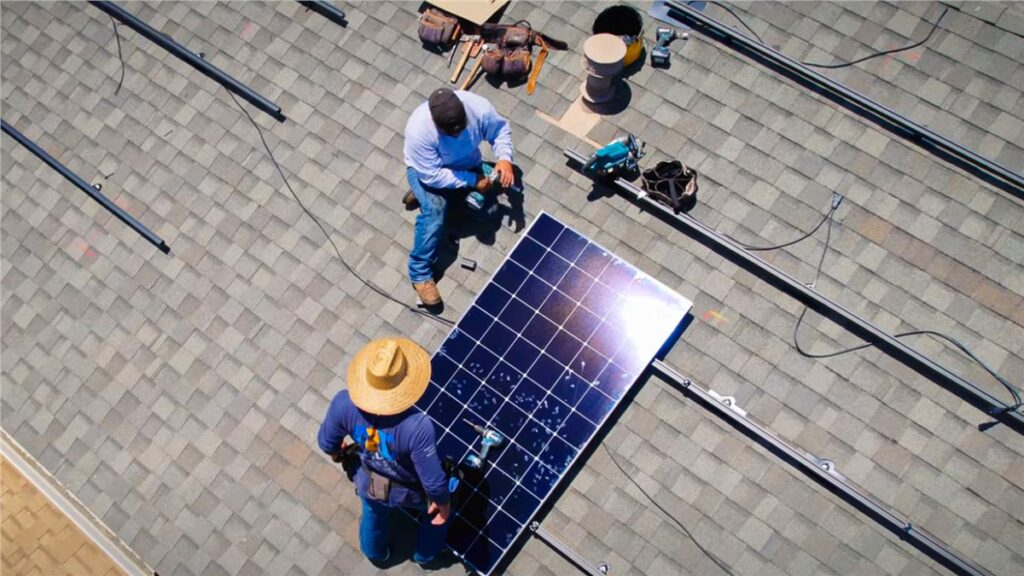
When you purchase a solar panel system, you own every component: the panels, the inverter, the racking, and the wiring. You can pay cash upfront or finance the purchase through a solar loan. Either way, the system belongs to you from day one.
Ownership means you are responsible for maintenance, though modern solar panels require very little. Most tier-one panels carry 25-year performance warranties, and inverters typically carry 12- to 25-year warranties depending on the manufacturer. Occasional cleaning and an annual inspection are usually all that is needed.
The financial upside of ownership is significant. You qualify for the federal solar Investment Tax Credit (ITC), which currently covers 30% of total system costs including installation. A system that costs $28,000 before incentives would yield an $8,400 tax credit. California does not currently offer a separate state solar tax credit, but net metering through Edison (known as NEM 3.0) allows you to receive credits for surplus energy your system exports to the grid.
With a purchased system, your home also gains equity. According to the U.S. Department of Energy, homes with owned solar panel systems sell for approximately 4% more than comparable homes without solar. That translates to meaningful added value in the Thousand Oaks real estate market, where median home prices exceed $900,000.
Solar Panel Leasing vs Buying: Side-by-Side Comparison
The following comparison covers the major factors Thousand Oaks homeowners weigh when choosing between leasing and buying solar panels.
Upfront cost: Leasing requires $0 down in most agreements. Buying requires either a cash payment (typically $20,000 to $35,000 for a residential system) or a solar loan with monthly payments.
Monthly savings: Both options reduce your electricity costs. Leasing saves you 20% to 40% on day one. Buying saves you more over time, especially once the system is paid off and your electricity is essentially free.
Tax credits: The 30% federal ITC goes to the system owner. If you lease, the leasing company claims it. If you buy, you claim it.
Maintenance responsibility: Under a lease or solar PPA, the provider handles all maintenance. Under ownership, you are responsible, though warranties cover most issues for 25 years.
Home value impact: Owned solar systems increase property value. Leased systems generally do not, and they can complicate a home sale because the lease must be transferred to the buyer or bought out.
Contract length: Leases run 20 to 25 years. Purchased systems have no contract. You own the equipment outright.
Flexibility: Buying gives you full control. Leasing ties you to the terms of the agreement, including potential escalator clauses and early termination fees.
Q: Can I switch from a lease to ownership later?
A: Many solar leases and PPAs include a buyout option, sometimes available after year 5 or 7. The buyout price is outlined in your contract and usually reflects the system’s fair market value at the time of purchase. Review this clause carefully before signing.
Pros of Leasing Solar Panels in Thousand Oaks
Leasing makes solar accessible to homeowners who cannot or prefer not to invest $20,000 or more upfront. Here are the specific advantages.
Zero or minimal upfront investment. You begin generating solar electricity without a down payment. For homeowners on a tight budget, this removes the primary barrier to going solar.
Predictable monthly payments. Your lease or PPA contract locks in a rate for the full term. In a market where Edison rates have increased an average of 5% to 7% annually, that predictability has real value.
No maintenance burden. The leasing company monitors system performance, handles inverter replacements, and covers repairs. You do not need to schedule cleaning or worry about panel degradation.
Immediate bill reduction. From month one, your combined solar lease payment plus any remaining Edison charges should be lower than what you were paying Edison alone. Most Thousand Oaks homeowners see a net reduction of $50 to $150 per month.
Pros of Buying Solar Panels in Thousand Oaks
Purchasing a solar panel system is the stronger long-term financial move for homeowners who can afford the upfront cost or qualify for favorable loan terms.
Federal tax credit. The 30% ITC reduces your net system cost by thousands of dollars. This credit is available through at least 2032 under current federal law.
Greater lifetime savings. A purchased system typically pays for itself within 6 to 9 years in the Thousand Oaks area. After that, your electricity is generated at no additional cost for the remaining 15 to 20 years of the system’s lifespan.
Increased home value. Owned solar panels are a tangible asset. In Thousand Oaks and neighboring communities like Westlake Village, Newbury Park, and Agoura Hills, buyers actively seek homes with solar because of the area’s high electricity costs and abundant sunshine.
Full control. You choose your equipment, your installer, and your maintenance schedule. There is no third-party contract governing what happens to the system.
Compatibility with battery storage. If you want to add a home battery system like the Tesla Powerwall or Enphase IQ Battery, ownership gives you full flexibility. California’s SGIP (Self-Generation Incentive Program) can offset battery costs, and pairing storage with owned panels maximizes your energy independence.
Q: Does buying solar panels make sense if I plan to sell my home in 5 years?
A: It can, especially in Thousand Oaks where home values are high. A purchased solar system adds to your asking price and appeals to buyers who want lower utility costs without inheriting a lease. However, if your timeline is very short, you may not recoup the full investment before selling.
What to Know Before Signing a Solar Lease in Thousand Oaks
Solar leasing through a PPA is a legitimate and popular option, but the contract details matter. Before you sign, review these key terms carefully.
Fixed rate vs. escalator clause. Some solar PPA contracts include an annual rate increase of 1% to 3%. Over 25 years, even a small escalator can significantly raise your total cost. Ask for a fixed-rate PPA if possible, and compare the year-25 projected cost against projected Edison rates.
Lease term length. Most solar leases in Thousand Oaks run 20 to 25 years. Make sure the term aligns with your homeownership plans. If you sell before the lease ends, the buyer must agree to assume the lease, or you will need to buy out the remaining balance.
Early termination fees. Ending a lease early typically triggers a fee that can range from several thousand dollars to the full remaining value of the contract. Understand the termination clause before committing.
System performance guarantee. Your PPA contract should include a minimum energy production guarantee. If the system underperforms, the provider should compensate you or repair the system at no cost.
Roof condition requirements. A solar lease provider will require that your roof is in good condition before installation. If your roof needs replacement, that work should be completed first. August Roofing and Solar handles both roofing and solar, which simplifies coordination and ensures your roof is ready for a 25-year solar commitment.
Still not sure what a solar PPA lease means for your home? Learn more about what a Solar PPA (Power Purchase Agreement) is here.
Who Should Lease Solar Panels?
A solar lease or PPA is the better fit for Thousand Oaks homeowners who meet most of the following criteria:
- You want to reduce your electricity bill immediately without a large cash outlay.
- You do not have enough tax liability to benefit from the 30% federal solar tax credit.
- You plan to stay in your home for at least 10 to 15 years.
- You prefer a hands-off experience where maintenance is handled for you.
- You value monthly payment predictability over long-term total savings.
Leasing is also a practical choice for homeowners who are not yet sure whether solar is right for them long term. Many lease agreements include a buyout option, so you can transition to ownership later if your financial situation changes.
Who Should Buy Solar Panels?
Purchasing solar panels is the stronger option for homeowners who:
- Can afford the upfront cost or qualify for a low-interest solar loan.
- Have sufficient federal tax liability to claim the 30% ITC.
- Want to maximize lifetime savings and eliminate electricity costs entirely after the payback period.
- Plan to add battery storage for backup power or to optimize NEM 3.0 credits.
- Want to increase their property’s resale value in the Thousand Oaks and Conejo Valley real estate market.
Homeowners in Westlake Village, Newbury Park, Moorpark, and Camarillo face similar Edison rate structures and climate conditions, so the financial math applies across the region.
How Thousand Oaks Climate Affects Your Solar Decision
Thousand Oaks is located in the Conejo Valley, an inland area of Ventura County that receives over 280 days of sunshine annually. The area experiences hot, dry summers with temperatures regularly exceeding 90 degrees, which drives high air conditioning usage and elevated Edison bills from June through October.
Unlike coastal communities that deal with persistent morning marine layer, Thousand Oaks generally has clear skies by mid-morning, resulting in strong solar production throughout the day. This climate profile means solar panels in Thousand Oaks produce more energy per panel than systems installed in many other parts of the country.
Wildfire risk is another factor. Thousand Oaks borders open space and wildfire-prone zones, so roof condition and material choices matter. If your roof is older or uses non-fire-rated materials, replacing it before solar installation is advisable. California’s Title 24 building code requires all new roofs to meet CAL FIRE Class A fire rating standards, and a combined roof-and-solar project ensures both systems are installed to current code.
August Roofing and Solar has served the Thousand Oaks area for over three decades, and our licensed team understands the specific structural, climate, and permitting requirements of Ventura County installations. We require no deposit to get started, whether you choose to lease or buy.
People Also Ask
Is it better to lease or buy solar panels in California?
For most California homeowners with sufficient tax liability and a long-term homeownership plan, buying solar panels provides greater lifetime savings and increases property value. Leasing is a better fit for homeowners who want immediate savings with no upfront cost and prefer maintenance-free operation.
What happens to a solar lease when you sell your house?
When you sell a home with a leased solar system, the buyer must agree to assume the lease, or you must buy out the remaining contract balance. Some buyers view an existing lease favorably because it lowers their electricity costs, while others prefer homes without third-party agreements.
Do solar panels increase home value in Thousand Oaks?
Owned solar panels typically increase home value by approximately 4% according to the U.S. Department of Energy. In the Thousand Oaks real estate market, where median home prices are above $900,000, that translates to a substantial increase. Leased panels generally do not add measurable value.
How much does a solar panel system cost in Thousand Oaks?
A typical residential solar panel system in Thousand Oaks costs between $20,000 and $35,000 before the federal tax credit. After applying the 30% ITC, the net cost drops to approximately $14,000 to $24,500. System size, panel brand, and whether battery storage is included all affect the final price.
Frequently Asked Questions
What is the difference between a solar lease and a solar PPA in Thousand Oaks?
A solar lease charges a flat monthly fee regardless of how much energy the system produces. A solar PPA (Power Purchase Agreement) charges you a per-kilowatt-hour rate for the electricity the panels actually generate. Both structures result in lower monthly costs than paying Edison directly, and both are widely available to Thousand Oaks homeowners.
Can I get solar panel leasing vs buying guidance from a local installer?
Yes. A qualified local installer like August Roofing and Solar can evaluate your roof, energy usage, and financial goals to recommend whether solar panel leasing vs buying in Thousand Oaks is the better path for your household. A site assessment is typically the first step.
Do I need a new roof before installing leased solar panels?
Most solar lease providers require your roof to be in good condition with at least 10 to 15 years of remaining lifespan. If your roof needs replacement, completing that work before solar installation avoids the cost of removing and reinstalling panels later. August Roofing and Solar handles both roofing and solar projects.
What happens at the end of a solar lease term?
At the end of a 20- or 25-year solar lease, you typically have three options: renew the lease at a reduced rate, purchase the system at fair market value, or have the leasing company remove the panels at no cost. Review your contract to confirm which options are available.
Is solar panel leasing vs buying in Thousand Oaks affected by NEM 3.0?
Yes. California’s NEM 3.0 net metering policy reduced the credit rate for solar energy exported to the grid, which makes battery storage more valuable for both leased and owned systems. Homeowners who buy their systems have more flexibility to add batteries and optimize self-consumption, while leased system configurations are determined by the leasing company.
Next Steps for Thousand Oaks Homeowners
Choosing between solar panel leasing vs buying in Thousand Oaks comes down to your budget, your timeline, and how much control you want over your energy system. Both paths reduce your electricity costs and move your home toward cleaner energy. The right choice is the one that fits your financial reality and homeownership plans.
If you are ready to explore your options, contact August Roofing and Solar for a free consultation. Our team will assess your roof, review your Edison billing history, and walk you through both leasing and purchasing options with transparent pricing and no deposit required. Call us at (805) 519-8099 or request an appointment online.