Key Takeaways
- Solar panel installation in Palisades requires a roofing-first approach to prevent leaks, structural damage, and voided warranties common with solar-only installers.
- SunPower panels with built-in microinverters convert DC to AC power at each panel, improving efficiency and enabling rapid shutdown for California code compliance.
- Pegasus flashing and rafter-anchored racking create a watertight, wind-resistant foundation that protects Palisades homes from coastal moisture and Santa Ana wind events.
- System mapping with individual serial numbers allows precise monitoring so underperforming panels can be identified and addressed immediately.
- California’s NEM (Net Energy Metering) program and the federal solar tax credit make Palisades one of the most financially favorable locations for residential solar in Southern California.
Quick Links
- Why Solar Panel Installation Matters for Palisades Homeowners
- Why SunPower Technology Is the Standard for Palisades Homes
- Step-by-Step Solar Panel Installation Palisades Process
- Why Roofing Expertise Is Critical for Solar Installation
- System Mapping and Monitoring for Your Solar Roof in Palisades CA
- The SunPower and August Roofing Difference
- California Solar Incentives and Programs for Palisades Residents
- People Also Ask
- Frequently Asked Questions
Why Solar Panel Installation Matters for Palisades Homeowners
If you are a homeowner in Palisades weighing whether solar panel installation is worth the investment, you are likely dealing with a familiar frustration: rising electricity bills from Southern California Edison with no clear end in sight. Rate hikes have become an annual reality in Southern California, and Palisades residents face some of the highest utility costs in the state. The decision is not just about going green. It is about taking control of a household expense that keeps climbing.
Solar panel installation in Palisades is particularly effective because of the region’s high UV index, abundant sunshine, and California’s supportive policy framework. But the quality of the installation matters as much as the panels themselves. A poorly installed system can cause roof leaks, void your roofing warranty, and underperform for years before you realize something is wrong.
This guide walks you through the complete solar panel installation process, explains the technology involved at a component level, and covers what makes a roofing-first approach the safest path for your home and investment.
Why SunPower Technology Is the Standard for Palisades Homes
SunPower solar panels are among the highest-efficiency residential panels available today. They consistently convert more sunlight into electricity per square foot than most competing brands, which matters on Palisades rooftops where usable space may be limited by roof angles, vents, or skylights.
SunPower offers two primary residential lines: the M-series and the U-series. Both deliver high output per panel, but the M-series is designed for maximum efficiency on smaller roof areas, while the U-series provides strong performance at a more accessible price point. Each panel includes a built-in microinverter, which we will explain in detail below.
What matters for homeowners is this: SunPower panels are engineered to maintain output over a 25-year warranty period with minimal degradation. Independent testing by the U.S. Department of Energy’s Solar Energy Technologies Office consistently ranks SunPower among the top performers in real-world residential conditions.
Q: Are SunPower panels worth the higher cost compared to budget brands?
A: SunPower panels produce more energy per square foot and degrade more slowly over time. For Palisades homeowners with limited roof space or partial shading from nearby trees, higher efficiency per panel typically delivers better long-term value than installing more low-cost panels.
Step-by-Step Solar Panel Installation Palisades Process
Solar panel installation is not a single-day event. It is a multi-phase process that begins with your roof and ends with a fully connected, grid-tied energy system. Here is how each step works at a technical level.
Step 1: Roof Assessment and Preparation
Before any solar hardware touches your roof, the existing roofing system must be evaluated. This includes checking the age of your shingles or tiles, inspecting the underlayment, and verifying that the roof deck and rafters can support the added load of panels and racking.
If your roof is within five years of needing replacement, it is more cost-effective to re-roof first. Removing solar panels later to replace a failing roof adds thousands of dollars in labor. In Palisades, where coastal moisture and salt air can accelerate shingle wear, this assessment is especially important.
Step 2: Pegasus Flashing Installation
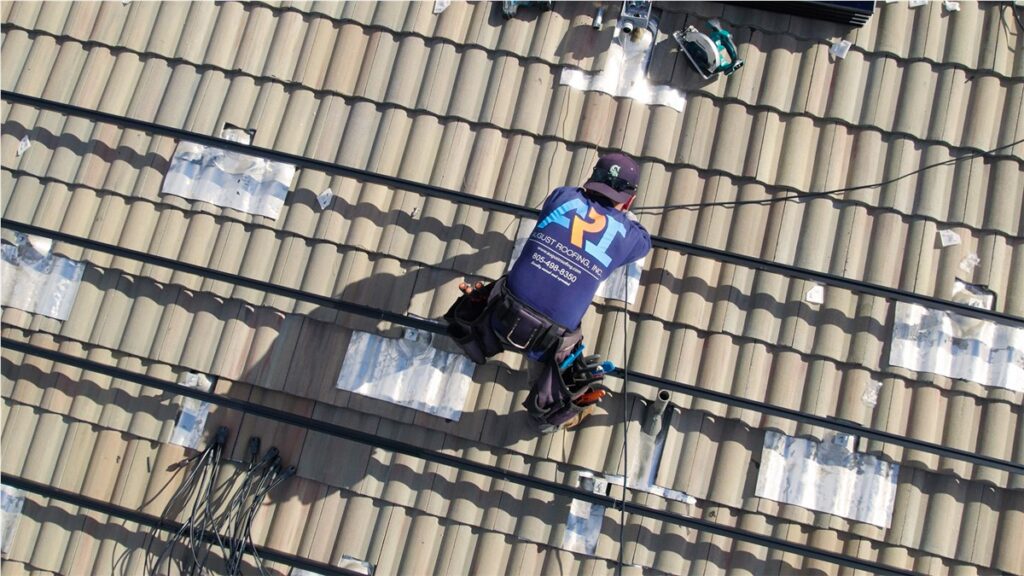
Pegasus flashing is the waterproofing component that seals every roof penetration point where racking hardware is bolted through the roof surface. Each flashing unit is set with mastic applied in a U-shaped pattern. This creates a drainage channel that directs any moisture away from the penetration rather than trapping it underneath.
This step is where most solar-only companies cut corners. Without proper flashing, roof penetrations become leak points within one to three years, especially in areas like Palisades where winter rain and coastal condensation test every seal on your roof.
Step 3: Racking System and Secure Foundation
The racking system is the aluminum rail framework that holds your panels at the correct angle for maximum sun exposure. Each rail is anchored directly into the roof rafters, not just the plywood decking, using lag bolts secured through the Pegasus flashing.
Rafter attachment is critical. Panels mounted only to decking can loosen during Santa Ana wind events, which regularly bring sustained gusts of 40 to 60 mph through Palisades and surrounding communities like Malibu, Pacific Palisades, and Topanga. Rafter anchoring provides the structural strength to resist uplift forces.
Q: Can solar panels be installed on tile roofs common in Palisades?
A: Yes. Tile roofs require specialized tile hooks and comp-outs, which involve removing tiles at attachment points and replacing them with flat composite sections under the flashing. This preserves the waterproof integrity of the tile roof while providing a solid mounting surface.
Step 4: Panel Placement and Microinverter Connection
SunPower AC panels include a built-in microinverter on each panel. A microinverter converts DC (direct current) electricity generated by the solar cells into AC (alternating current) electricity that your home’s electrical system uses. This conversion happens at each individual panel rather than at a single central inverter, which means that shading or debris on one panel does not reduce the output of the entire array.
Each panel clicks into the racking system and connects to the adjacent panel through a simple wiring trunk. SunPower engineered the connection system to be modular so that panels can be added or repositioned if your energy needs change.
Built-in microinverters also satisfy California’s rapid shutdown requirement. In an emergency, firefighters or utility workers can de-energize the system at the panel level within seconds. This is a code requirement under NEC 2017 and Title 24.
Why Roofing Expertise Is Critical for Solar Panel Installation in Palisades
The most common problems homeowners encounter after solar installation are not electrical. They are roofing problems. Leaks around mounting points, cracked tiles from foot traffic during installation, and improperly sealed flashing are responsible for the majority of solar-related warranty claims nationwide.
This is why the installer’s roofing competence matters as much as their solar credentials. A company that understands roof systems at the underlayment, flashing, and drainage level will protect your home in ways a solar-only installer cannot.
August Roofing and Solar was a roofing company for decades before adding solar services. With over 30 years of experience in Southern California, our crews are trained roofers first. They understand how water moves across a roof surface, where vulnerable points develop over time, and how to seal penetrations so they remain watertight for the life of the system. We also require no deposit to begin work, which reflects confidence in the quality of every installation.
Q: What happens if my roof needs replacement after solar panels are already installed?
A: The panels and racking must be removed, the roof replaced, and the solar system reinstalled. This typically adds $2,000 to $5,000 in labor costs. Having a roofing-qualified installer evaluate your roof before solar installation prevents this expensive scenario.
System Mapping and Monitoring for Your Solar Roof in Palisades CA
After installation, every panel’s serial number is recorded and mapped to its exact position on your roof. This is called system mapping, and it serves two practical purposes.
First, it enables panel-level monitoring through the SunPower app. You can see how much energy each individual panel is producing in real time. If one panel drops in output due to debris, a wiring issue, or a failing cell, the system identifies exactly which panel needs attention.
Second, system mapping simplifies warranty service. If a panel needs replacement under SunPower’s 25-year warranty, the mapped serial number allows the service team to pull the correct replacement unit and locate it on your roof without guesswork.
For Palisades homeowners, monitoring is especially useful during the spring months when marine layer clouds are most persistent along the coast. Panel-level data lets you confirm whether your solar roof in Palisades CA is performing as expected or whether coastal fog is reducing output beyond normal levels.
The SunPower and August Roofing Difference in Palisades
Choosing a solar installer is a decision that affects your home for 25 years or more. The panels on your roof will outlast most appliances, your current car, and potentially your next roof. The quality of the installation determines whether those years are trouble-free or marked by leaks, service calls, and frustration.
August Roofing and Solar pairs SunPower’s highest-efficiency panels with installation practices built on 30 years of roofing expertise across Southern California. We are licensed, certified, and familiar with the specific building codes and climate conditions that affect homes in Palisades and neighboring areas like Santa Monica, Brentwood, and Malibu.
Every installation includes a full roof inspection before work begins, Pegasus flashing at every penetration point, rafter-anchored racking, and panel-level system mapping. These are not upgrades. They are baseline standards.
California Solar Incentives and Programs for Palisades Residents
Palisades homeowners have access to several financial programs that reduce the net cost of going solar.
The federal Investment Tax Credit (ITC) currently allows homeowners to deduct 30% of total solar installation costs from their federal income taxes. This applies to panels, inverters, racking, labor, and battery storage if added.
California’s NEM (Net Energy Metering) program, administered through the California Public Utilities Commission (CPUC), allows Palisades homeowners on Southern California Edison to receive bill credits for excess solar energy sent back to the grid. Under NEM 3.0, the credit rates have shifted, making battery storage a more strategic addition for maximizing savings.
The SGIP (Self-Generation Incentive Program) offers rebates for battery storage systems, which pair with solar panels to store excess daytime energy for use during evening peak-rate hours. For Palisades homes subject to occasional Public Safety Power Shutoffs during wildfire season, battery backup also provides resilience during grid outages.
People Also Ask
How long does solar panel installation take in Palisades?
Most residential solar panel installations in Palisades take one to three days for the physical installation. However, permitting, utility interconnection, and final inspection can add two to six weeks before the system is fully operational and connected to Southern California Edison’s grid.
Do solar panels damage your roof?
Solar panels do not damage your roof when installed correctly. Damage occurs when installers skip proper flashing, fail to anchor into rafters, or walk carelessly on tile surfaces. A qualified roofing and solar installer prevents all three issues.
How much do solar panels cost in Palisades, California?
The average residential solar installation in Palisades costs between $15,000 and $30,000 before incentives, depending on system size and roof complexity. After the 30% federal tax credit, net costs typically fall between $10,500 and $21,000.
Is solar worth it in Palisades with NEM 3.0 changes?
Solar remains financially worthwhile in Palisades under NEM 3.0, especially when paired with battery storage. The combination allows homeowners to store excess energy and use it during high-rate evening hours rather than exporting it at lower credit rates.
Frequently Asked Questions
What is the best type of solar panel for solar panel installation in Palisades?
SunPower panels are among the best options for Palisades homes due to their high efficiency per square foot and strong performance in partial-shade conditions caused by coastal marine layer. Their built-in microinverters also simplify installation and meet California rapid shutdown codes.
Does solar panel installation Palisades require a roof replacement first?
Not always. If your roof is in good condition with at least 10 to 15 years of remaining life, solar panels can be installed directly using Pegasus flashing and rafter-anchored racking. If your roof is older or showing signs of wear, a re-roof before solar installation is the more cost-effective path.
How does a microinverter differ from a string inverter?
A microinverter is installed on each individual panel and converts DC to AC power at the source. A string inverter connects all panels in series and converts power at a single central unit. Microinverters allow each panel to operate independently, so shading on one panel does not reduce the output of the entire system.
Will solar panels work during a power outage in Palisades?
Standard grid-tied solar panels shut down during a power outage for safety reasons. However, adding a battery storage system allows your solar panels to continue powering your home during outages, which is particularly valuable during Public Safety Power Shutoffs in wildfire-prone areas near Palisades.
How do I get started with solar panel installation in Palisades?
The first step is a professional roof and site assessment to evaluate your roof condition, sun exposure, and energy needs. Contact August Roofing and Solar to schedule a free inspection. Our team will assess your roof, design a system tailored to your home, and walk you through available incentives, all with no deposit required.
If you are a homeowner in Palisades considering solar panel installation, the right starting point is understanding your roof’s condition and your home’s energy profile. Call August Roofing and Solar at (805) 519-8099 or request a free quote online to begin with a no-obligation roof and solar assessment.