
Key Takeaways
- A solar battery in Montecito stores excess daytime solar energy so homeowners can use it during expensive peak hours (4 PM to 9 PM) instead of buying power from Southern California Edison at inflated Time-of-Use rates.
- Under California’s NEM 3.0 policy, the credits Edison pays for exported solar energy dropped roughly 75%, making battery storage the most effective way to protect your solar investment and reduce monthly bills.
- Solar battery storage in Southern California also provides backup power during grid outages, which are increasingly common during wildfire season and Public Safety Power Shutoffs (PSPS) in the Montecito area.
- California’s Self-Generation Incentive Program (SGIP) offers rebates that can significantly reduce the upfront cost of adding battery storage to a residential solar system.
- Montecito homeowners who pair solar panels with battery storage maximize their return on investment by consuming more of the energy they generate rather than exporting it at reduced credit rates.
Quick Links
- Why a Solar Battery Matters for Montecito Homeowners
- How NEM 3.0 Changed the Economics of Solar in Montecito
- The Peak-Hour Problem: When Solar Panels Stop Producing
- How a Solar Battery System Works
- Solar Battery Montecito: Key Benefits for Homeowners
- California Rebates and Incentives for Solar Battery Storage
- Choosing the Right Solar Battery for Your Montecito Home
- People Also Ask
- Frequently Asked Questions
Why a Solar Battery Matters for Montecito Homeowners
A solar battery in Montecito is now one of the most important components of a residential solar system. Without one, homeowners face a gap between when their panels produce energy and when they actually need it most.
If you have solar panels on your Montecito home and your electric bill still seems higher than expected, you are not alone. Many homeowners across the Santa Barbara coast invested in solar expecting near-zero utility bills, only to discover that recent policy changes in California have shifted the financial equation. The credits you once earned by sending excess power to the grid have dropped sharply. Meanwhile, the hours when electricity costs the most are the exact hours when your panels produce the least.
This is not a flaw in your solar system. It is a structural change in how California utilities value rooftop solar energy. Understanding how a solar battery addresses this gap is the first step toward reclaiming the savings you expected when you went solar.
How NEM 3.0 Changed the Economics of Solar in Montecito
NEM 3.0, also called the Net Billing Tariff, is California’s updated net metering policy that took effect in April 2023. Under the previous NEM 2.0 system, the arrangement was straightforward: for every kilowatt-hour (kWh) of solar energy you exported to the grid, you received a credit roughly equal to the retail rate you would have paid for that same energy. It was essentially a one-to-one trade.
NEM 3.0 changed that equation dramatically. The export compensation rate, which is the credit Southern California Edison pays you for excess solar energy sent to the grid, dropped by approximately 75%. A kWh that once earned you around $0.30 in credit may now earn closer to $0.05 to $0.08, depending on the time of day and season.
For Montecito homeowners, this means the old strategy of overproducing solar energy during the day and relying on generous credits to offset evening usage no longer works. The math simply does not support it.
Q: Does NEM 3.0 apply to existing solar systems in Montecito?
A: Homeowners who installed solar under NEM 2.0 are grandfathered into that rate structure for 20 years from their interconnection date. NEM 3.0 applies to new solar installations permitted after April 14, 2023.
Q: Can I still save money with solar panels under NEM 3.0?
A: Yes, but the savings model has shifted. Under NEM 3.0, the greatest savings come from self-consuming your solar energy rather than exporting it. A solar battery makes this possible by storing daytime production for evening use.
The California Public Utilities Commission (CPUC) designed NEM 3.0 to encourage battery adoption. The policy effectively makes solar battery storage in Southern California a financial necessity rather than an optional upgrade.
The Peak-Hour Problem: When Solar Panels Stop Producing
Solar panels generate electricity when sunlight hits them. In Montecito, that production window typically runs from around 7 AM to 5 PM, peaking midday when the sun is directly overhead. The coastal marine layer common along the Santa Barbara coastline can reduce morning production slightly, but overall, Montecito receives excellent solar irradiance year-round thanks to its Southern California location and high UV index.
The problem is timing. Southern California Edison’s Time-of-Use (TOU) rate schedule charges the highest electricity prices during peak hours, which run from 4 PM to 9 PM. This is exactly when most homeowners need the most energy: cooking dinner, running air conditioning as afternoon heat lingers in the foothills, doing laundry, charging devices, and keeping the household running.
By 5 PM or 6 PM, your solar panels are producing a fraction of their midday output. By 7 PM, production is essentially zero. Without a battery, you are buying electricity from Edison at the most expensive rate of the day.
This mismatch between solar production and energy demand is called the “duck curve” in energy planning. It is the core reason why a solar battery in Montecito is no longer a luxury. It is the component that makes your solar system financially complete.
How a Solar Battery System Works
A solar battery is an energy storage device that connects to your solar panel system through an inverter. During the day, your panels generate direct current (DC) electricity. Your inverter converts this to alternating current (AC), which is the type of electricity your home appliances use.
When your panels produce more energy than your home is consuming, the excess flows into the battery rather than being exported to the grid. The battery stores this energy as chemical energy, typically using lithium-ion or lithium iron phosphate (LFP) chemistry.
When the sun sets and your panels stop producing, the battery discharges stored energy back through the inverter and into your home’s electrical panel. This happens automatically. You do not need to flip switches or monitor anything manually.
Key Components of a Home Battery System
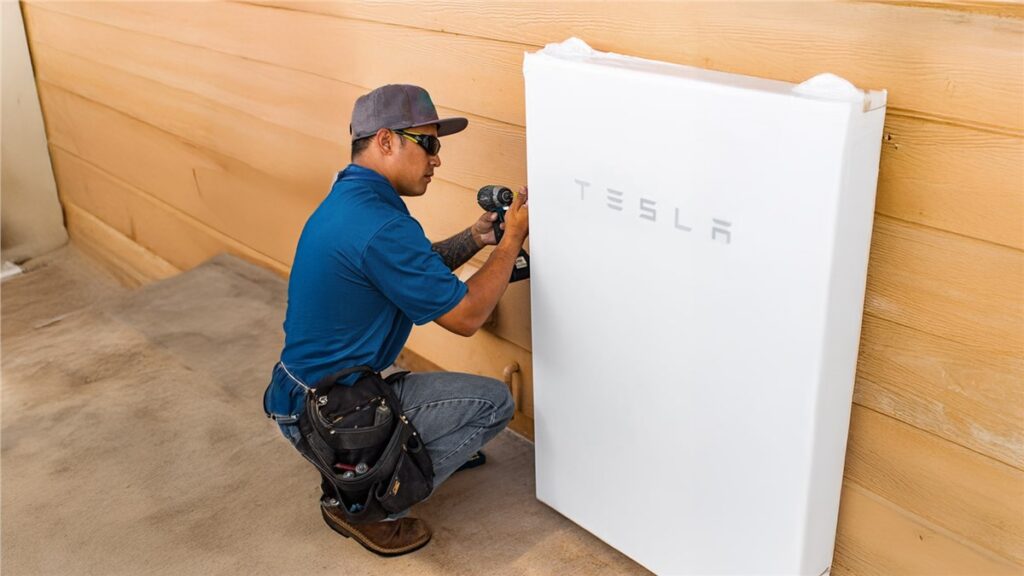
- Battery unit: The physical storage device, usually wall-mounted in a garage or on an exterior wall. Common residential units range from 10 kWh to 20 kWh of usable capacity.
- Hybrid inverter or battery inverter: Manages the flow of electricity between your panels, battery, home, and the grid.
- Energy management system: Software that optimizes when the battery charges and discharges based on your TOU rate schedule and energy usage patterns.
- Automatic transfer switch (ATS): If your system is configured for backup power, this component detects grid outages and switches your home to battery power within milliseconds.
The entire system operates silently and requires minimal maintenance. Most modern solar batteries carry warranties of 10 to 15 years.
Q: Where is the solar battery installed on a Montecito home?
A: Most solar batteries are installed on an exterior wall or inside a garage. The unit needs to be in a location that stays within the manufacturer’s specified temperature range. In Montecito’s mild coastal climate, outdoor installation is typically suitable year-round.
Solar Battery in Montecito: Key Benefits for Homeowners
Adding a solar battery to your Montecito solar system delivers measurable financial and practical advantages. Here is what changes when you add storage to your system.
Eliminate Peak-Hour Charges
This is the primary financial benefit. Instead of buying electricity from Southern California Edison at peak TOU rates, which can exceed $0.50 per kWh during summer months, your battery supplies the energy your home needs from 4 PM to 9 PM. The electricity stored in your battery is energy you already generated for free from sunlight. Using it during peak hours means you avoid the most expensive electricity on Edison’s rate schedule entirely.
For a typical Montecito household consuming 8 to 12 kWh during peak hours, this can translate to meaningful monthly savings that compound over the life of the system.
Backup Power During Outages
Montecito and the surrounding Santa Barbara foothills face real grid reliability concerns. CAL FIRE and Edison sometimes initiate Public Safety Power Shutoffs (PSPS) during high Santa Ana wind events to reduce wildfire ignition risk. These shutoffs can last hours or even days.
Without a battery, your solar panels shut down during a grid outage. This is a safety requirement, as it prevents your panels from sending electricity into power lines that utility workers may be repairing. A solar battery with an automatic transfer switch isolates your home from the grid and keeps your solar system running in “island mode,” powering your home independently.
Neighbors in Carpinteria, Summerland, and the broader Santa Barbara area face the same outage risks, making battery storage relevant throughout the region.
Maximize Your Solar Investment
Under NEM 3.0, every kWh you export to the grid earns a fraction of what it costs to buy that same kWh back during peak hours. A solar battery closes this gap by letting you consume your own solar energy when it is most valuable. Instead of selling low and buying high, you store and use it yourself.
This self-consumption model is now the most effective way to achieve the electric bill savings that originally motivated your solar installation.
Increase Home Value
Research from the Lawrence Berkeley National Laboratory has shown that homes with solar systems sell for a premium. Adding battery storage further differentiates your property in a market like Montecito, where energy independence and resilience are increasingly valued by buyers.
Q: How long can a solar battery power a Montecito home during an outage?
A: Duration depends on battery capacity and your energy usage. A single 13.5 kWh battery powering essential loads like refrigeration, lighting, Wi-Fi, and phone charging can last 10 to 24 hours. Larger battery configurations or reduced usage can extend this further. If your solar panels are producing during the day, the battery recharges and can sustain your home indefinitely in many cases.
California Rebates and Incentives for Solar Battery Storage Southern California
California offers several financial incentives that reduce the cost of adding battery storage to your home solar system.
Self-Generation Incentive Program (SGIP)
The SGIP is a California rebate program administered by the state’s investor-owned utilities, including Southern California Edison. It provides per-watt-hour rebates for qualifying battery storage systems. Rebate levels vary based on available funding and whether you are in a designated high-fire-threat area.
Many parts of Montecito and the surrounding Santa Barbara foothills fall within CAL FIRE’s high-fire-threat districts, which can qualify homeowners for enhanced “equity” or “equity resiliency” SGIP rebates. These enhanced rebates can cover a significant portion of the battery’s cost.
Federal Investment Tax Credit (ITC)
The federal solar tax credit, currently at 30%, applies to battery storage systems installed alongside or added to a solar panel system. This is a dollar-for-dollar tax credit, not a deduction. It applies to the full cost of the battery, including installation labor.
For a battery system costing $12,000 to $15,000 before incentives, the 30% ITC alone reduces the net cost by $3,600 to $4,500.
Combined Savings
- Federal ITC: 30% of total battery system cost
- SGIP rebate: Varies, but can range from $200 to $1,000 per kWh of capacity depending on eligibility tier
- TOU savings: Ongoing monthly reduction in electricity costs for the life of the battery
August Roofing and Solar helps Montecito homeowners navigate these incentive programs as part of every solar installation project. With over 30 years of experience in Southern California, we handle the paperwork and ensure you receive every rebate and credit you qualify for.
Choosing the Right Solar Battery for Your Montecito Home
Not all solar batteries are the same. The right choice depends on your household’s energy usage, your goals for backup power coverage, and your budget. Here are the key specifications to evaluate.
Usable Capacity (kWh)
This is the amount of energy the battery can store and deliver. Most residential batteries range from 10 kWh to 20 kWh per unit. A typical Montecito home uses 20 to 30 kWh per day total, with roughly 8 to 12 kWh consumed during peak hours. A single battery in the 13 to 15 kWh range often covers peak-hour needs. Homeowners who want whole-home backup during outages may need two or more units.
Power Output (kW)
This measures how much electricity the battery can deliver at any given moment. A battery with 5 kW of continuous output can run several appliances simultaneously but may not support high-draw equipment like central air conditioning or an electric vehicle charger. Higher-output batteries or multi-battery configurations handle larger loads.
Round-Trip Efficiency
This is the percentage of energy stored that you actually get back when the battery discharges. A battery with 90% round-trip efficiency returns 9 kWh for every 10 kWh stored. Higher efficiency means less energy is lost in the storage process. Most modern lithium-ion batteries achieve 88% to 96% round-trip efficiency.
Chemistry and Lifespan
Lithium iron phosphate (LFP) batteries are increasingly popular for residential use because they offer longer cycle life, greater thermal stability, and no cobalt content compared to nickel-manganese-cobalt (NMC) alternatives. In Montecito’s moderate climate, both chemistries perform well, but LFP batteries typically last longer and carry warranties of up to 15 years.
Warranty Terms
Look for warranties that guarantee a minimum retained capacity, often 70% to 80% of original capacity, after a specified number of years or charge cycles. A strong warranty reflects the manufacturer’s confidence in the product’s longevity.
At August Roofing and Solar, we are licensed and certified installers who work with leading battery manufacturers. We assess your home’s energy profile, roof orientation, and electrical panel capacity before recommending a battery configuration. We require no deposit to begin the process, and every installation is backed by our workmanship warranty. Learn more about our team and credentials.
People Also Ask
Is a solar battery worth it in Southern California?
Yes. Under NEM 3.0 and Edison’s TOU rate structure, a solar battery allows homeowners to use stored solar energy during peak hours instead of buying expensive grid electricity. The combination of avoided peak charges, federal tax credits, and California’s SGIP rebate makes battery storage a financially sound investment for most Southern California homes.
How much does a solar battery cost in Montecito?
A residential solar battery system in Montecito typically costs between $10,000 and $18,000 before incentives, depending on battery capacity and installation complexity. After the 30% federal tax credit and any applicable SGIP rebates, the net cost can be significantly lower.
Can solar panels work during a power outage without a battery?
No. Without a battery, grid-tied solar panels are required to shut down during a power outage to protect utility workers. A solar battery with an automatic transfer switch allows your system to operate independently from the grid, keeping your home powered during outages.
How long do solar batteries last?
Most residential solar batteries last 10 to 15 years, depending on usage patterns, charge cycles, and battery chemistry. Lithium iron phosphate (LFP) batteries tend to have longer lifespans than other lithium-ion chemistries. Warranties typically guarantee 70% to 80% retained capacity over the warranty period.
Frequently Asked Questions
Why do Montecito homeowners need a solar battery under NEM 3.0?
Under NEM 3.0, the credits Southern California Edison pays for exported solar energy dropped approximately 75% compared to NEM 2.0. A solar battery in Montecito allows homeowners to store excess daytime solar production and use it during peak TOU hours (4 PM to 9 PM) when grid electricity is most expensive. This self-consumption strategy is now the primary way to maximize solar savings in California.
What size solar battery do I need for my Montecito home?
Most Montecito homes benefit from a battery with 13 to 15 kWh of usable capacity, which typically covers peak-hour energy consumption. Homes with higher energy usage, electric vehicle charging needs, or a desire for whole-home backup during outages may require two or more battery units. A site assessment determines the right configuration for your specific energy profile.
Does a solar battery Montecito installation qualify for rebates?
Yes. A solar battery installation in Montecito qualifies for the 30% federal Investment Tax Credit and may qualify for California’s SGIP rebate, especially if your property is in a designated high-fire-threat area. These incentives can reduce the net cost of a battery system by 30% to 50% or more.
Can I add a solar battery to my existing solar panel system?
Yes. A solar battery can be retrofitted to most existing solar panel systems. The process typically involves adding a battery inverter or replacing your current inverter with a hybrid model that manages both solar and battery functions. A qualified installer will evaluate your existing system’s compatibility and electrical panel capacity before recommending a solution.
How does a solar battery help during wildfire-related power shutoffs in Montecito?
During Public Safety Power Shutoffs (PSPS), which Edison initiates during high Santa Ana wind conditions to reduce wildfire risk, a solar battery with an automatic transfer switch keeps your home powered independently. Your solar panels recharge the battery during the day, and the battery provides electricity at night, allowing your home to operate off-grid for the duration of the shutoff.
Take Control of Your Energy in Montecito
A solar battery in Montecito is the component that makes your solar investment work the way you originally expected. It bridges the gap between when your panels produce energy and when your home needs it, eliminates peak-hour charges from Southern California Edison, and provides reliable backup power during grid outages.
If you are considering solar battery storage for your Montecito home, or if you already have solar panels and want to add a battery, contact August Roofing and Solar to schedule a free consultation. We will assess your energy usage, roof configuration, and available incentives to design a system that fits your home and budget. You can also call us directly at (805) 519-8099. We serve homeowners throughout Montecito, Santa Barbara, Carpinteria, and the surrounding Southern California communities.