
Key Takeaways
- Combining roofing and solar installation in Santa Clarita under one contractor eliminates the risk of voided roof warranties and reduces the chance of penetration-related leaks by ensuring solar standoffs are integrated during the roofing process itself.
- Santa Clarita’s inland climate, with high UV exposure, Santa Ana winds, and summer temperatures regularly exceeding 100 degrees, makes it essential to install a roof system designed from the start to support solar panel loads and thermal cycling.
- A combined roof and solar project with a single licensed contractor typically costs 10 to 15 percent less than hiring separate companies, while also cutting total project time roughly in half.
- California’s Title 24 solar mandate for new construction and NEM 3.0 net metering rules make it financially strategic to pair a new roof with solar and potentially battery storage at the same time.
- August Roofing and Solar has served Southern California for over 30 years, requires no deposit to start work, and handles roofing, solar, and electrical under one roof license.
Quick Links
- Why Combining Roofing and Solar Matters in Santa Clarita
- How a Combined Roofing and Solar Installation Works Step by Step
- How Integrated Solar Standoffs Prevent Roof Leaks
- Santa Clarita Climate Considerations for Roofing and Solar
- Cost and Time Savings of a Combined Roof and Solar Project
- California Incentives and Regulations That Affect Your Decision
- Choosing the Right Contractor for Combined Roof and Solar in Santa Clarita
- People Also Ask
- Frequently Asked Questions
Why Combining Roofing and Solar Matters in Santa Clarita
If you are a homeowner in Santa Clarita considering solar panels, there is a good chance your roof is also approaching the end of its useful life. Many homes in Valencia, Saugus, Canyon Country, and Newhall were built during the development booms of the 1980s and 1990s, which means their original composition shingle roofs are now 25 to 35 years old. That puts you in an uncomfortable position: install solar panels on a roof that may need replacement within a few years, or delay solar savings while you figure out the roofing side.
This is the exact scenario where combining roofing and solar installation in Santa Clarita into a single project makes the most practical and financial sense. When two separate companies handle each project independently, the solar installer drills into a roof system they did not build. If the roof later develops a leak at a penetration point, the roofer may deny the warranty claim because another contractor altered the roof. The solar company, in turn, points back to the roofer. The homeowner is left in the middle.
A combined project under one contractor removes that liability gap entirely. Every penetration, flashing detail, and sealant application is the responsibility of one team.
How a Combined Roofing and Solar Installation Works Step by Step
A combined roof and solar installation follows a carefully sequenced process. Understanding each phase helps homeowners set realistic timelines and know what to expect on their property during the project.
Phase 1: Inspection and System Design
The project begins with a thorough roof inspection. A qualified estimator evaluates the existing roof deck, identifies any plywood damage or dry rot, checks attic ventilation, and documents the current roofing material and condition. At the same time, the solar design team assesses roof orientation, pitch angles, shading from nearby trees or structures, and available square footage for panel placement.
For Santa Clarita homes, south-facing and west-facing roof planes typically produce the highest annual energy output. The design team uses satellite imagery and on-site measurements to model expected solar production based on the home’s specific geometry and local sun exposure patterns.
Phase 2: Tear-Off and Roof Deck Preparation
The existing roofing material is removed down to the plywood deck. The crew inspects every square foot of decking for moisture damage, delamination, or structural weakness. Damaged plywood sheets are replaced. In Santa Clarita, where summer attic temperatures can exceed 150 degrees, the condition of the decking is a critical factor in the long-term performance of both the roof and the solar array mounted above it.
Phase 3: Underlayment and Roofing Installation
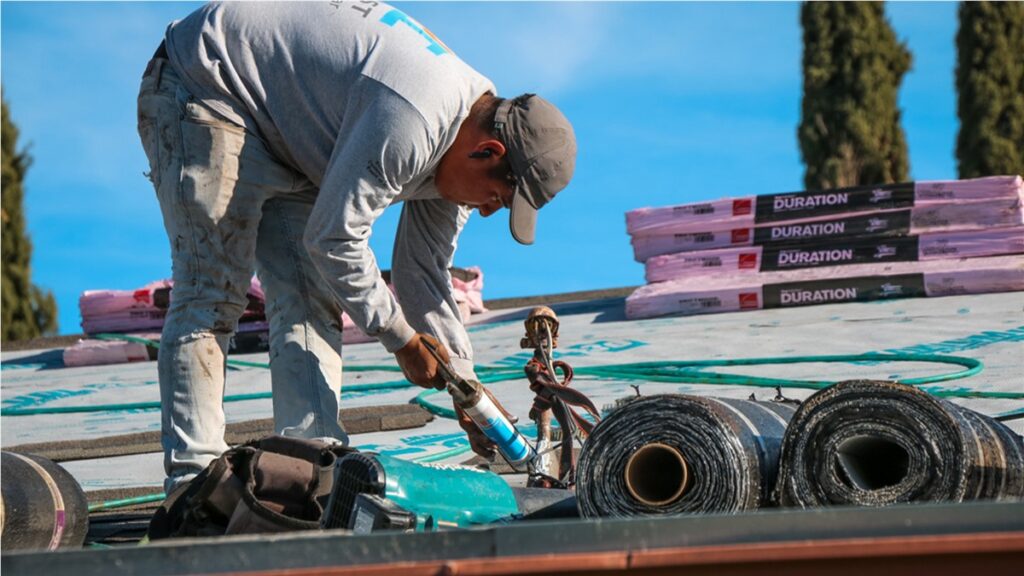
A synthetic underlayment is installed across the entire roof deck, followed by the primary roofing material. Whether the homeowner selects composition shingles, concrete tile, or a cool roof system, the roofers install solar standoffs at predetermined locations during this phase rather than after the roof is finished. This is the single most important difference between a combined project and a separated one.
Phase 4: Solar Panel Mounting and Wiring
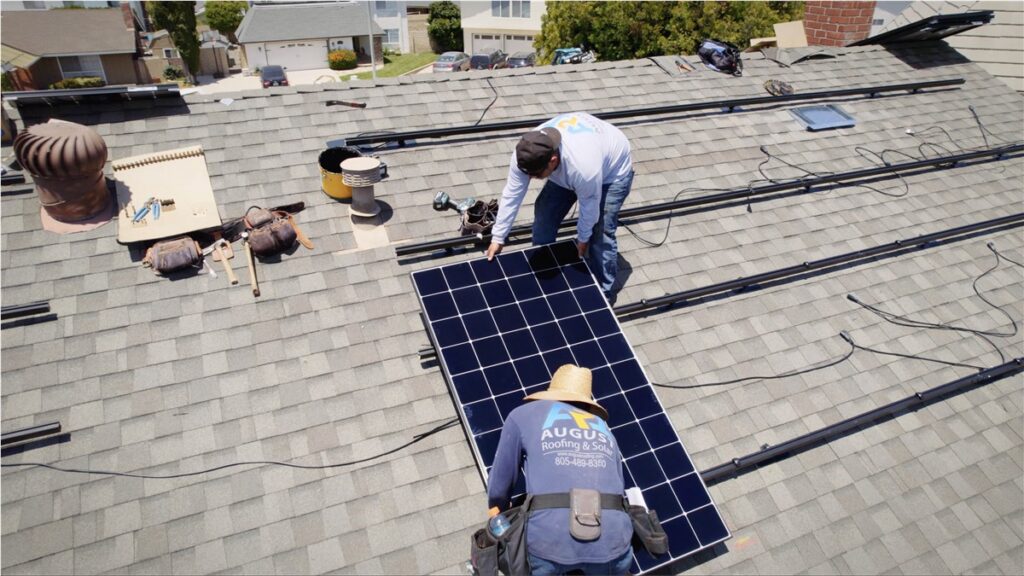
Once the roof is complete and the standoffs are in place, the solar crew attaches the racking rails directly to the pre-installed standoffs. Panels are mounted, microinverters or string inverters are connected, and all wiring is routed to the main electrical panel. Because the standoffs were flashed and sealed as part of the roofing process, there is no need to cut back into a finished roof surface.
Phase 5: Electrical Integration and Inspection
The electrical team connects the solar array to the home’s electrical panel, installs the monitoring system, and prepares the system for city inspection and utility interconnection. In Santa Clarita, this means coordinating with the city of Santa Clarita building department and Southern California Edison (SCE) for Permission to Operate (PTO).
Q: How long does a combined roof and solar project take?
A: Most combined roofing and solar installation projects for a standard single-family home in Santa Clarita take 5 to 10 business days for the physical work. The permitting and SCE interconnection process adds 4 to 8 weeks depending on current processing times.
How Integrated Solar Standoffs Prevent Roof Leaks
Roof leaks at solar panel attachment points are one of the most common problems homeowners face when solar is installed by a company that is not also the roofer. Understanding why this happens requires a brief explanation of how solar panels attach to a roof.
Solar panels do not sit directly on the roofing material. They are elevated above the roof surface on a racking system made of aluminum rails. Those rails are bolted to the roof deck through components called standoffs, which are metal brackets that penetrate the roofing material and anchor into the plywood or rafters below.
Each standoff creates a penetration, which is a hole through the waterproof barrier of your roof. When a separate solar installer drills these penetrations into a finished roof, they must cut through shingles or tiles, apply sealant around the bracket, and hope the seal holds for 25 years. Sealant degrades over time, especially under Santa Clarita’s intense UV exposure and thermal cycling.
In a combined installation, the standoffs are placed before the final roofing material is applied. The roofer flashes around each standoff with the same metal flashing and underlayment system used at every other roof penetration, such as vent pipes and chimneys. This method integrates the standoff into the roof’s waterproofing system rather than cutting through it after the fact.
Q: Can I add solar to my existing roof without replacing it?
A: Yes, but only if your roof has at least 10 to 15 years of remaining useful life. If it will need replacement within that window, you would end up paying to remove and reinstall the solar panels, which typically costs $2,000 to $5,000. It is more cost-effective to combine both projects now.
Santa Clarita Climate Considerations for Roofing and Solar
Santa Clarita sits in an inland valley north of Los Angeles, and its climate creates specific demands on both roofing systems and solar arrays that differ from coastal communities like Oxnard or Santa Monica.
Heat and Thermal Cycling
Summer daytime temperatures in Santa Clarita regularly exceed 100 degrees Fahrenheit. Roof surface temperatures can reach 160 to 170 degrees on dark-colored shingles. This extreme heat causes roofing materials to expand during the day and contract at night, a process called thermal cycling. Over time, thermal cycling weakens sealant bonds and can cause cracking in lower-quality shingles.
For solar panels, heat actually reduces electrical output. Panels are rated at a standard test condition of 77 degrees Fahrenheit. For every degree above that, most silicon panels lose about 0.3 to 0.4 percent efficiency. This means choosing a roofing material with high solar reflectance, sometimes called a cool roof, can lower surface temperatures and marginally improve panel performance.
Santa Ana Winds
Santa Clarita is directly in the path of Santa Ana wind events, which can produce sustained winds of 40 to 60 mph with gusts exceeding 80 mph. Both roofing materials and solar panel racking must be engineered to withstand these loads. Properly installed solar panels actually add wind uplift resistance to the roof in some configurations, because the racking system creates additional attachment points to the roof deck.
Wildfire Risk and Ember-Resistant Roofing
Portions of Santa Clarita, particularly areas near the Angeles National Forest and the Placerita Canyon area, fall within CAL FIRE-designated Wildland-Urban Interface zones. Homes in these zones must meet CAL FIRE Chapter 7A requirements for ember-resistant roofing. Class A fire-rated roofing materials are mandatory. When combining a roof replacement with solar, it is essential that the roofing material selected meets these fire ratings and that solar panel placement does not create debris traps where embers could accumulate.
High UV Index
Santa Clarita’s inland position and minimal cloud cover produce a consistently high UV index throughout the year. While this is excellent for solar energy production, averaging 5.5 to 6.0 peak sun hours per day, it accelerates the degradation of roofing materials. This makes material selection especially important. Investing in a high-quality 50-year architectural shingle or concrete tile ensures the roof will outlast the 25-year production warranty on most solar panels.
Cost and Time Savings of a Combined Roof and Solar Project in Santa Clarita
Hiring one contractor to handle both roofing and solar installation in Santa Clarita produces measurable savings in three categories: direct cost reduction, time compression, and warranty simplification.
Direct Cost Reduction
When a single company manages both scopes of work, there is only one mobilization, one permit application (in many cases), and one set of overhead costs. The roofing crew does not need to return to the site to accommodate a separate solar installer. The solar crew does not need to spend time evaluating and working around a roof they did not install. These efficiencies typically result in a project cost that is 10 to 15 percent lower than the combined price of two separate contracts.
Time Compression
A separated project often unfolds over several months. You schedule the roofer, wait for completion, then schedule the solar company, wait for their design and permitting, and then wait for installation. A combined project compresses this into a single continuous timeline. For most Santa Clarita homes, the physical installation takes one to two weeks instead of spreading across two to three months.
Warranty Simplification
With a combined project, one company warrants the entire system. If a leak develops near a solar standoff five years from now, there is no finger-pointing between two companies. August Roofing and Solar provides a single workmanship warranty covering the roof installation and the solar panel mounting system, giving homeowners in Santa Clarita clear, uncomplicated protection.
Q: Does combining roof and solar qualify for additional financing options?
A: Yes. Many homeowners finance the combined project through a single solar loan that covers both the roof and the solar system, since the roof is a necessary component of the solar installation. This can simplify payments and may offer better terms than a separate roofing loan.
California Incentives and Regulations That Affect Your Decision
Several California-specific policies directly influence the financial equation of a combined roof and solar project in Santa Clarita.
Federal Solar Investment Tax Credit (ITC)
The federal ITC currently provides a 30 percent tax credit on the total cost of a residential solar installation. When the roof replacement is required to support the solar installation (which is the case when the existing roof is too old or damaged to safely mount panels), the IRS allows the cost of the new roof to be included in the tax credit calculation. This can represent thousands of dollars in additional savings.
NEM 3.0 Net Metering
California’s current net metering policy, NEM 3.0, significantly reduced the credit homeowners receive for exporting excess solar energy to the grid through Southern California Edison. Under NEM 3.0, the economics of solar shift in favor of self-consumption and battery storage. For Santa Clarita homeowners, this means pairing solar with a battery system at the time of installation is now more financially important than it was under previous net metering rules.
Title 24 Solar Mandate
California’s Title 24 building code requires solar panels on all new residential construction. While this does not directly apply to existing homes undergoing a roof replacement, it signals the state’s direction and supports long-term property value for homes with solar already installed.
SGIP Battery Rebate
The Self-Generation Incentive Program (SGIP) provides rebates for battery storage systems. Homeowners in high fire-threat districts, which includes parts of Santa Clarita, may qualify for enhanced rebates covering a larger percentage of battery costs. Pairing a battery with your combined roof and solar project can be especially valuable if your neighborhood experiences Public Safety Power Shutoffs during fire season.
Choosing the Right Contractor for Combined Roof and Solar in Santa Clarita
Not every roofing company installs solar, and not every solar company understands roofing. When evaluating contractors for a combined roofing and solar installation in Santa Clarita, homeowners should verify several specific qualifications.
Licensing
In California, roofing requires a C-39 roofing contractor license, and solar installation requires either a C-46 solar contractor license or a C-10 electrical contractor license. A company performing both should hold the appropriate licenses for each scope of work. Verify license status through the California Contractors State License Board.
Experience with Both Systems
Ask how many combined roof and solar projects the contractor has completed. A company that added solar to its services last year does not bring the same integration expertise as one that has been performing both for over a decade. August Roofing and Solar has more than 30 years of roofing experience in Southern California and has been performing integrated roof and solar installations throughout the Santa Clarita Valley, Ventura County, and the greater Los Angeles area for years.
Warranty Coverage
Request written documentation of what the warranty covers. Specifically confirm that the workmanship warranty covers both the roofing installation and the solar panel mounting penetrations. Confirm the duration and whether the warranty is transferable if you sell the home.
Deposit Policy
Be cautious of contractors who require large upfront deposits. August Roofing and Solar requires no deposit to begin work, which reduces homeowner risk and demonstrates confidence in project execution.
People Also Ask
Is it worth getting a new roof with solar panels in Santa Clarita?
Yes. If your roof is more than 15 years old, combining a roof replacement with solar panel installation avoids the future cost of removing and reinstalling panels when the roof eventually needs replacement. The combined project also qualifies for a larger federal tax credit since the roof cost may be included.
How much does a combined roof and solar installation cost in Santa Clarita?
Costs vary based on roof size, material, and solar system size, but a typical combined project for a 2,000 square foot Santa Clarita home ranges from $35,000 to $55,000 before the federal tax credit. The 30 percent ITC can reduce out-of-pocket costs significantly.
Do solar panels damage your roof?
Solar panels do not damage a properly prepared roof. Problems arise when panels are installed by a company that is not the roofer, because the penetrations may not be integrated into the roof’s waterproofing system. A combined installation eliminates this risk.
How long do solar panels last in Southern California?
Most solar panels carry a 25-year production warranty and can continue generating electricity for 30 to 35 years. Southern California’s high sun exposure maximizes production throughout the panel’s lifespan, making the region one of the best in the country for residential solar.
Frequently Asked Questions
What is the best time of year for roofing and solar installation in Santa Clarita?
Spring and fall offer the most comfortable working conditions, but roofing and solar installation in Santa Clarita can be performed year-round due to the region’s dry climate. Summer installations are common, though high heat may slightly extend daily work schedules.
Can I claim the federal tax credit if I combine roofing and solar installation in Santa Clarita?
Yes. The 30 percent federal Investment Tax Credit applies to the solar installation cost. When a new roof is required to support the solar system, the IRS allows the roofing cost to be included in the credit calculation. Consult a tax professional for guidance specific to your situation.
Will my homeowner’s insurance increase if I add solar panels?
Most insurance providers cover solar panels under the existing homeowner’s policy as a permanent attachment to the home. Some insurers may require a coverage increase to reflect the added value of the solar system. Contact your insurance provider before installation to confirm.
How does roofing and solar installation in Santa Clarita work with HOA requirements?
California law (Solar Rights Act) prohibits HOAs from banning solar panel installations. However, HOAs may have guidelines on panel placement and visibility. Your contractor should be familiar with local HOA requirements in Santa Clarita communities such as Valencia, Westridge, and Stevenson Ranch.
Does August Roofing and Solar handle permits and utility interconnection?
Yes. August Roofing and Solar manages the full permitting process with the city of Santa Clarita and coordinates interconnection with Southern California Edison, including the application for Permission to Operate. Homeowners do not need to manage any of the paperwork.
Next Steps for Santa Clarita Homeowners
If your roof is aging and you have been considering solar, combining both projects into a single roofing and solar installation in Santa Clarita is the most practical path forward. It protects your roof warranty, lowers your total cost, and gives you one point of contact for the entire project.
Contact August Roofing and Solar to schedule a free roof inspection and solar assessment. You can also call us directly at (805) 519-8099. We will evaluate your roof condition, model your solar production potential, and provide a clear proposal for the combined project. No deposit is required to get started, and our roofing and solar teams work together from day one.