Key Takeaways
- A trustworthy roofing and solar company uses its own trained employees rather than day laborers or subcontractors, which directly impacts workmanship quality and accountability on your home.
- Legitimate contractors offer transparent project detailing, daily photo updates, and honest on-the-spot pricing so homeowners never face surprise charges or hidden fees.
- Choosing how to choose a roofing contractor comes down to verifying real reviews, understanding the payment structure, and confirming the company prioritizes diagnosis over aggressive sales tactics.
- High-efficiency solar panels like SunPower, installed by crews who understand roof systems, deliver long-term energy savings and avoid future structural damage common with less experienced installers.
- In Southern California, where intense UV exposure, Santa Ana winds, and wildfire risk stress roofing systems, hiring a company with 30+ years of regional experience reduces the chance of costly callbacks.
Quick Links
- Why Choosing the Right Roofing and Solar Company Matters
- Proof of Vision: Real Reviews and Team Passion
- No Day Laborers or Subcontractors
- Daily Photo Updates on Your Home
- No Money Down: Pay Only When Satisfied
- Service Over Selling: Diagnosis Before Recommendation
- Roofing and Solar Project Detailing
- Quality First: Long-Term Value Over Lowest Price
- The Best Solar Panels and Installer Expertise
- People Also Ask
- Frequently Asked Questions
Why Choosing the Right Roofing and Solar Company Matters Before You Sign Anything
You have probably heard the horror stories. A roofing and solar company collects a large deposit, sends a revolving crew of strangers to your property, then disappears when problems surface six months later. In Southern California, where roofing systems endure relentless UV radiation, Santa Ana wind events, and wildfire-adjacent ember exposure, the consequences of hiring the wrong contractor extend well beyond cosmetic issues. A failed roof installation can lead to water intrusion, voided warranties, and tens of thousands of dollars in structural repairs.
The challenge for homeowners is that most contractors sound the same on their websites. Everyone claims quality. Everyone claims experience. So how do you actually tell the difference between a company that will protect your home and one that will create new problems?
This post walks through eight specific ways to evaluate a roofing and solar company, told from the perspective of a project consultant who sees firsthand what separates reliable contractors from unreliable ones. These are not vague promises. They are operational practices you can verify before signing a contract. If you are learning how to choose a roofing contractor in this market, these eight points give you a concrete checklist.
Proof of Vision: Real Reviews and Team Passion
The most reliable indicator of a roofing and solar company’s real-world performance is its review history. Not a handful of curated testimonials on a website, but an extensive, verifiable track record on third-party platforms like Google Business Profile. A pattern of detailed, positive reviews from homeowners describing specific experiences, such as clean job sites, clear communication, or crews arriving on time, tells you more than any marketing claim.
At August Roofing and Solar, with over 30 years of experience serving Southern California, every team member operates under the belief that professionalism and construction are not mutually exclusive. That philosophy shows up in hundreds of Google reviews that consistently highlight workmanship quality, respectful crews, and follow-through on promises.
When you are evaluating contractors, look for patterns in reviews rather than isolated five-star ratings. Repeated mentions of specific behaviors, like daily communication or thorough cleanup, indicate systemic practices rather than one good day.
Q: How many reviews should a roofing company have before I trust them?
A: There is no magic number, but a company with at least 50 to 100 verified Google reviews spanning multiple years demonstrates consistency. Look for recency as well. A company with strong reviews from three years ago but nothing recent may have changed ownership, staffing, or practices.
No Day Laborers or Subcontractors: Why Your Roofing and Solar Company’s Workforce Matters
One of the most overlooked questions when learning how to choose a roofing contractor is whether the company uses its own employees or hires subcontractors and day laborers. This distinction has a direct impact on workmanship quality, accountability, and your legal exposure as a homeowner.
When a company subcontracts labor, the workers on your roof have no long-term relationship with the company whose name is on your contract. They may not be trained on that company’s specific installation methods. If something goes wrong, the subcontractor may not carry adequate insurance, and the general contractor may disclaim responsibility for their work.
A company that employs its own trained crews invests in ongoing skill development, quality control, and consistent installation standards. These employees take ownership of their work because their professional reputation and continued employment depend on it.
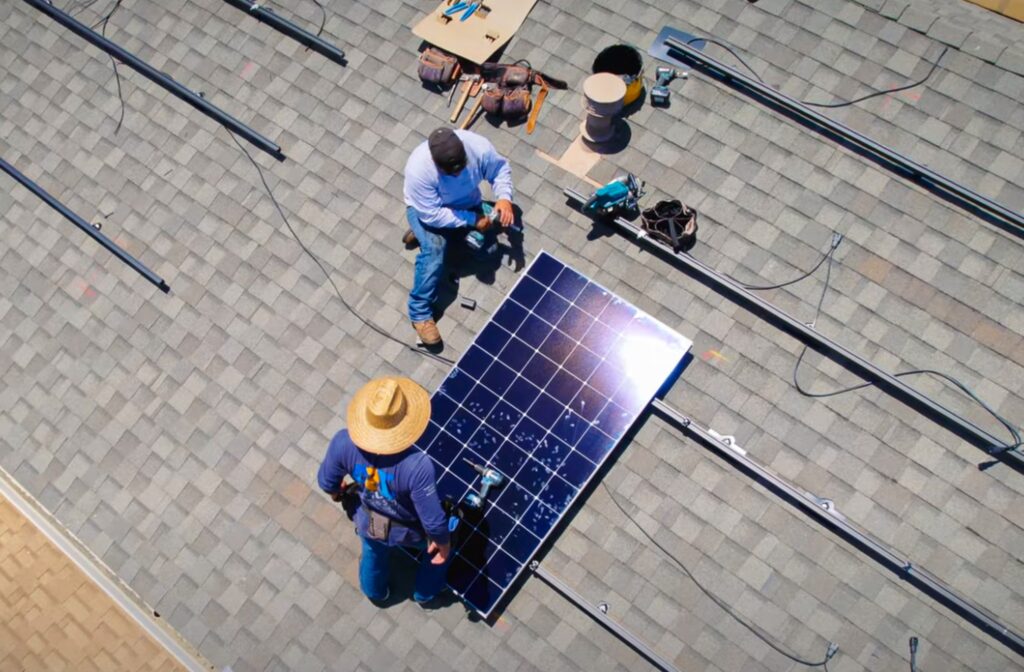 Solar panel removal and reinstallation handled by trained professionals working in coordination to protect your roof and system.
August Roofing and Solar does not use day laborers or subcontractors. Every person on your roof is a direct employee, trained in the company’s installation protocols. This model creates a chain of accountability from the project consultant who designs your scope of work to the installer who drives the last fastener.
Q: How can I verify that a contractor uses their own employees?
A: Ask directly and request proof of workers’ compensation insurance for their crew. Companies that subcontract often cannot provide a single workers’ comp policy covering everyone on the job. You can also check with the California Contractors State License Board (CSLB) to verify the company’s license status and any complaints related to subcontractor disputes.
Daily Photo Updates on Your Home
A roofing or solar installation can last several days, and most homeowners cannot monitor the work in real time. They leave for work in the morning and return to find progress has been made, but they have no way to verify what was done, how it was done, or whether any issues arose during the day.
Daily photo documentation solves this problem. A roofing and solar company that captures and shares progress photos each day gives you a visual record of every phase of work. This practice serves multiple purposes. It holds the crew accountable to documented standards. It gives the homeowner confidence that the scope of work matches what was agreed upon. And it creates a permanent record that can be referenced for future warranty claims or insurance documentation.
This is particularly valuable in Southern California, where roofing systems must meet specific standards. For homes in wildfire-prone areas, CAL FIRE requires ember-resistant roofing assemblies that include specific underlayment and material configurations. Photo documentation proves these components were installed correctly, which matters if you ever need to file an insurance claim after a fire event.
August Roofing and Solar provides daily photo updates on every project, allowing homeowners to monitor progress from their phone or computer without needing to be on-site.
No Money Down: Pay Only When You Are Satisfied
The payment structure a contractor uses reveals a great deal about their confidence in their own work. Many roofing companies require deposits of 30 to 50 percent before work begins. While deposits are common across the construction industry, they create a power imbalance. Once a contractor holds a significant portion of the project cost, the homeowner’s leverage to address quality issues or delays diminishes considerably.
A no-money-down policy inverts that dynamic. When a roofing and solar company collects payment only after the work is complete and the homeowner is satisfied, the financial incentive stays aligned with quality outcomes throughout the entire project.
This payment structure is uncommon in the roofing industry, which is precisely why it functions as a strong trust signal. A company that offers this model is confident that the finished product will meet or exceed the homeowner’s expectations.
August Roofing and Solar requires no deposit on roofing or solar projects. Payment is collected only when the work is finished and the homeowner confirms satisfaction. This policy applies to all residential projects, whether it is a full roof replacement or a new solar panel installation.
Q: Is no money down common for roofing contractors?
A: No. Most roofing contractors require a deposit before starting work, typically ranging from 10 to 50 percent of the total project cost. A no-money-down policy is rare and generally indicates that the contractor has strong financial stability and high confidence in their workmanship quality.
Service Over Selling: How a Trustworthy Roofing and Solar Company Diagnoses Before Recommending
The sales process itself is one of the clearest indicators of a contractor’s priorities. A high-pressure sales approach, one that pushes you toward a decision during the first visit with limited-time discounts or scare tactics, benefits the company at the expense of the homeowner’s informed decision-making.
A service-first approach works differently. The project consultant acts more like a diagnostician than a salesperson. They inspect the roof system, identify specific conditions such as granule loss on asphalt shingles, flashing deterioration around penetrations, or inadequate ventilation in the attic space, and explain what they find in plain language before recommending any course of action.
This diagnostic approach is especially important when homeowners are considering solar panel installation. Solar panels are designed to remain on a roof for 25 years or longer. If the underlying roof has only five to eight years of remaining useful life, installing panels on top of it creates a future problem. The panels will eventually need to be removed, the roof replaced underneath, and the panels reinstalled, roughly doubling the total project cost.
A responsible consultant identifies this issue upfront. If your roof needs attention before it can support a solar array, that information should come before any solar proposal, not after you have already signed a contract.
This is how to choose a roofing contractor who genuinely serves your interests. Look for a company whose first step is inspection and education, not a quote.
Roofing and Solar Project Detailing: Transparent Pricing and Process
Transparent project detailing means the homeowner understands every element of the job before work begins. This includes the specific materials being used, such as the manufacturer and product line of shingles or tiles. It includes the crew size and expected timeline. It covers color options, material alternatives, and the sequence of work from the day the crew arrives to final cleanup.
A detailed project walkthrough also covers pricing. After a thorough roof assessment, you should receive a written quote on the spot. That quote should itemize labor, materials, permits, and any applicable fees. If financing is available, the terms should be clearly stated. If there are alternative solutions at different price points, those options should be presented side by side so you can make an informed comparison.
This level of transparency protects you from the most common complaints about contractors: unexpected charges, scope changes mid-project, and vague descriptions of what was actually done. According to the National Roofing Contractors Association (NRCA), unclear scope of work is one of the leading causes of disputes between homeowners and roofing contractors.
At August Roofing and Solar, the project detailing process is designed to ensure alignment before a single shingle is lifted. You receive an on-the-spot quote after your roof inspection, along with financing options and alternative solutions. There is no pressure to move forward immediately. The decision is yours, on your timeline.
Quality First: Why Long-Term Value Beats the Lowest Price
Southern California’s climate places extraordinary demands on roofing systems. Prolonged UV exposure degrades asphalt shingles and sealants faster than in more temperate climates. Thermal cycling, where daytime temperatures in inland valleys can exceed 100 degrees Fahrenheit before dropping 40 degrees overnight, causes expansion and contraction that loosens fasteners and cracks brittle materials. Santa Ana winds, which can sustain speeds above 60 mph, test every edge detail, flashing termination, and ridge cap on the roof.
In this environment, the difference between a budget installation and a quality installation is not theoretical. It shows up as premature failure, leaks, or wind damage within the first five to ten years. The homeowner who saved money on the initial installation ends up paying significantly more over the life of the roof.
A quality-first roofing and solar company makes material and installation decisions based on long-term performance rather than minimizing the upfront bid. This means selecting underlayment rated for high-temperature environments, using fastener patterns that meet or exceed wind uplift requirements for Southern California, and installing flashing systems designed for the specific roof geometry rather than using generic one-size-fits-all details.
The principle applies equally to solar installations. Cutting costs on mounting hardware, conduit routing, or inverter selection can result in system underperformance, roof penetration failures, or code compliance issues that surface during a home sale inspection.
Budget constraints are real, and a responsible contractor acknowledges them. But the conversation should center on value per year of service life rather than lowest initial cost. A roof that costs 15 percent more but lasts 10 years longer delivers far better value per dollar.
The Best Solar Panels and Installer Expertise for Southern California Homes
Not all solar panels perform equally, and in Southern California’s high-UV environment, panel efficiency and degradation rate matter more than in regions with lower solar irradiance. SunPower panels consistently rank among the highest-efficiency residential solar panels available, with cell efficiencies exceeding 22 percent. Higher efficiency means more electricity production per square foot of roof space, which is particularly important for homes with limited south-facing roof area.
SunPower panels also carry one of the strongest warranties in the residential solar industry, covering both product defects and power output degradation for 25 years. This warranty provides long-term financial predictability. You know what your system will produce and what is covered if it does not.
However, even the best solar panel will underperform or cause problems if installed incorrectly. Solar installation is fundamentally a roofing activity. Every panel mount requires roof penetrations that must be properly sealed and flashed to prevent water intrusion. The mounting system must distribute load correctly across the roof structure. Conduit runs and inverter placement must comply with California’s Title 24 energy code and local fire setback requirements.
This is where installer expertise becomes as important as panel quality. A roofing and solar company whose crews understand roof systems at a structural level, not just electrical connections, can ensure that your solar installation does not compromise your roof’s waterproofing integrity. August Roofing and Solar installs SunPower panels with crews who are trained in both roofing and solar disciplines, which means the roof system and the solar array are treated as a single integrated assembly rather than two separate projects layered on top of each other.
For homeowners considering solar under California’s current net billing tariff (NEM 3.0), pairing high-efficiency panels with battery storage through programs like SGIP (Self-Generation Incentive Program) can maximize the financial return on a residential solar investment.
People Also Ask
What should I look for when hiring a roofing and solar company?
Look for verified reviews on third-party platforms, proof that the company uses its own employees rather than subcontractors, transparent pricing with itemized quotes, and a payment structure that does not require large upfront deposits. Confirm the company holds a valid California contractor’s license through the CSLB.
Why do some roofing companies require no money down?
A no-money-down policy signals that the contractor is financially stable and confident in the quality of their finished work. It keeps the financial incentive aligned with homeowner satisfaction throughout the project. This practice is uncommon in the industry, which makes it a useful differentiator when comparing contractors.
How do I know if my roof is ready for solar panels?
A qualified contractor will inspect your roof’s age, condition, and structural capacity before proposing solar. If your roof has fewer than 10 to 15 years of remaining useful life, it typically makes sense to replace or repair the roof before installing solar panels to avoid the cost of removing and reinstalling them later.
Are SunPower solar panels worth the higher cost?
SunPower panels offer cell efficiencies above 22 percent and a 25-year comprehensive warranty covering both product and performance. In Southern California’s high-UV environment, higher efficiency means more energy production per square foot, which can offset the higher upfront cost through greater long-term electricity savings.
Frequently Asked Questions
What makes a roofing and solar company trustworthy?
A trustworthy roofing and solar company uses its own trained employees, provides transparent itemized pricing, does not require large deposits, and has a verifiable track record of positive reviews. They diagnose your roof’s condition before recommending solutions rather than leading with a sales pitch.
Does August Roofing and Solar require a deposit?
No. August Roofing and Solar requires no money down on any roofing or solar project. Payment is collected only after the work is complete and the homeowner confirms satisfaction with the results.
How do I choose a roofing and solar company in Southern California?
Start by verifying the company’s license with the California Contractors State License Board. Check for at least 50 verified Google reviews. Ask whether they use their own employees or subcontractors. Request an itemized written quote after an on-site inspection. And confirm their payment terms before signing any contract.
Why does it matter if a roofing and solar company uses subcontractors?
Subcontractors may not carry adequate insurance, may not be trained on the contracting company’s installation standards, and create gaps in accountability if workmanship issues arise. A company that employs its own crews maintains direct quality control over every aspect of your project.
What solar panels does August Roofing and Solar install?
August Roofing and Solar installs SunPower solar panels, which are among the highest-efficiency residential panels available with cell efficiencies exceeding 22 percent. SunPower panels include a 25-year warranty covering both product defects and power output degradation, making them a strong long-term investment for Southern California homeowners.
Choosing the right roofing and solar company is one of the most consequential decisions you will make as a Southern California homeowner. The eight differentiators outlined above, from verified reviews and in-house crews to transparent pricing and SunPower panel installations, provide a practical framework for evaluating any contractor you consider. If you would like to see these principles in action, schedule a free, no-obligation consultation with August Roofing and Solar or call (805) 519-8099 to speak with a project consultant who will start by listening, not selling.