
Key Takeaways
- Proper attic insulation is the single most effective way to minimize heat gain through your roof, reducing cooling costs by up to 15% in hot climates like Southern California.
- Roof ventilation systems, including ridge vents and soffit vents working together, prevent heat from building up in your attic and radiating into your living space.
- Cool roof materials and reflective coatings can lower roof surface temperatures by up to 50 degrees Fahrenheit, a significant advantage during inland Southern California summers.
- California Title 24 building codes now include cool roof requirements for many residential projects, making energy-efficient roofing both a performance upgrade and a compliance necessity.
- Combining insulation, ventilation, and reflective roofing into a coordinated system delivers far greater energy savings than any single improvement alone.
Quick Links
- Why Roof Heat Gain Matters in Southern California
- How Heat Enters Your Home Through the Roof
- Insulation: Your First Defense to Minimize Heat Gain Through Your Roof
- Ventilation Systems That Keep Your Attic Cool
- Cool Roof Materials and Reflective Coatings
- How Roof Color and Design Affect Heat Absorption
- Can Solar Panels Help Reduce Roof Heat Gain?
- California Title 24 and Cool Roof Southern California Requirements
- A Coordinated Approach: Combining Strategies for Maximum Savings
- People Also Ask
- Frequently Asked Questions
Why Roof Heat Gain Matters in Southern California
If your air conditioner runs nonstop from May through October and your energy bills keep climbing, your roof may be the reason. Many Southern California homeowners focus on upgrading their HVAC system or sealing windows without realizing that the roof is the largest surface area exposed to direct sunlight. In a region where inland temperatures regularly exceed 100 degrees Fahrenheit and the high UV index breaks down materials faster than in milder climates, understanding how to minimize heat gain through your roof is one of the most practical steps you can take to lower cooling costs and improve indoor comfort.
This is not just about comfort. Excess roof heat accelerates shingle deterioration, strains your air conditioning compressor, and can even affect indoor air quality when attic temperatures cause building materials to off-gas. The good news is that a few targeted upgrades, often completed during a routine roof replacement or maintenance visit, can dramatically reduce the amount of heat that transfers from your roof into your living space.
How Heat Enters Your Home Through the Roof
Heat enters your home through three mechanisms: conduction, convection, and radiation. Understanding these helps you choose the right solutions.
Conduction is the direct transfer of heat through solid materials. When the sun heats your roof surface, that thermal energy travels through the roofing material, into the roof deck (the plywood layer beneath), and into your attic. From there, it conducts through the ceiling into your living space.
Convection occurs when hot air rises and circulates. In a poorly ventilated attic, heated air has nowhere to go. It accumulates, raising the attic temperature to 150 degrees or higher, which then radiates heat downward into your home.
Radiation is the transfer of heat through electromagnetic waves. Your roof absorbs solar radiation and re-emits it as infrared energy. Dark-colored roofs absorb more radiation. Light-colored or reflective roofs bounce more of it away before it can convert to heat.
Effective heat gain reduction addresses all three of these pathways simultaneously. A single fix, like adding insulation alone, helps but leaves other pathways open.
Q: Which type of heat transfer causes the most roof heat gain?
A: In Southern California, radiation is the dominant factor because of the region’s intense sun exposure and high UV index. However, poor insulation (conduction) and inadequate ventilation (convection) amplify the problem significantly.
Insulation: Your First Defense to Minimize Heat Gain Through Your Roof
Proper attic insulation is the most effective single upgrade for reducing heat transfer from your roof into your home. Insulation works by slowing conductive heat transfer. The higher the R-value (a measure of thermal resistance), the better the material resists heat flow.
For Southern California homes, the U.S. Department of Energy recommends attic insulation between R-30 and R-60, depending on the specific climate zone. Many older homes in the region have far less, sometimes as little as R-11, which was considered acceptable decades ago but falls well short of current standards.
Common insulation types for residential attics include:
- Fiberglass batts: Pre-cut panels placed between ceiling joists. Affordable and widely available. R-value of about 3.2 per inch of thickness.
- Blown-in cellulose: Loose-fill material made from recycled paper, treated with fire retardant. Fills gaps and irregular spaces more completely than batts. R-value of about 3.7 per inch.
- Spray foam (open-cell or closed-cell): Applied as a liquid that expands to fill cavities. Closed-cell spray foam offers the highest R-value per inch (approximately 6.5) and also acts as an air barrier.
- Radiant barriers: Reflective foil sheets installed on the underside of roof rafters. These do not have a traditional R-value but reduce radiant heat transfer by up to 97%, according to the U.S. Department of Energy.
In many cases, adding a radiant barrier in combination with traditional insulation provides the best results. The radiant barrier reflects heat before it reaches the insulation, and the insulation slows whatever heat gets through.
Q: Is radiant barrier insulation worth it in Southern California?
A: Yes. Radiant barriers are especially effective in hot, sunny climates. Studies show they can reduce cooling costs by 5% to 10% when installed in attics that already have adequate insulation, and even more in under-insulated homes.
Ventilation Systems That Keep Your Attic Cool
Even with excellent insulation, a poorly ventilated attic traps hot air that radiates heat downward into your home. A balanced roof ventilation system allows fresh air to enter through intake vents and hot air to escape through exhaust vents, creating continuous airflow that keeps attic temperatures closer to outdoor ambient levels.
The two main components of a residential roof ventilation system are:
Intake vents (soffit vents): Installed along the underside of the roof eaves, or soffits. These allow cooler outside air to enter the attic at the lowest point of the roofline. Continuous soffit vents are generally more effective than individual round or rectangular vents because they distribute airflow more evenly.
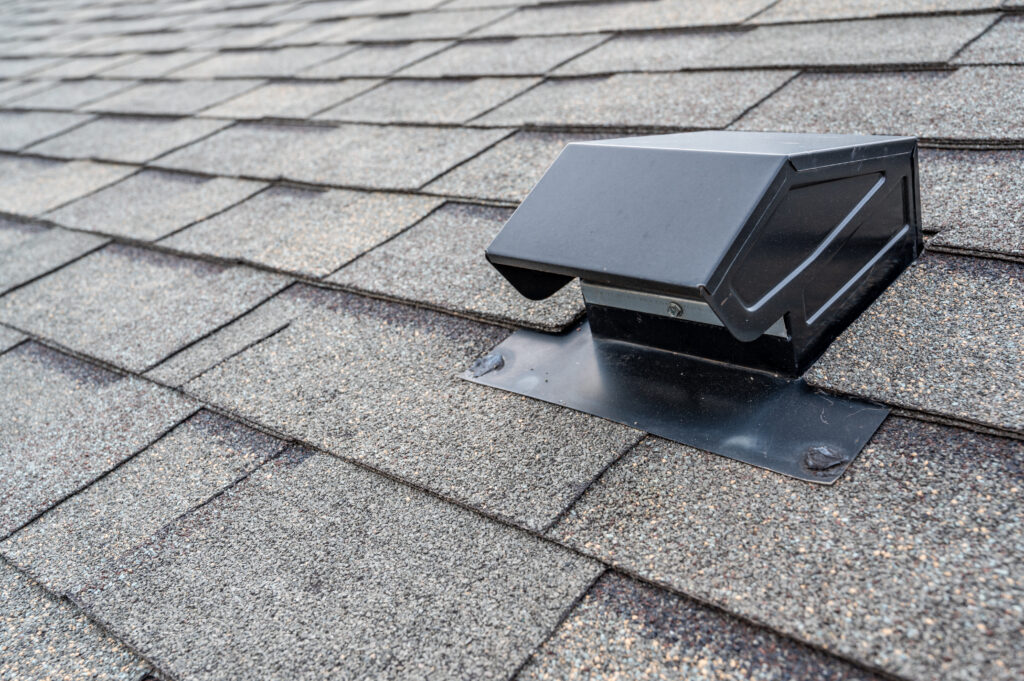
Exhaust vents: Installed at or near the roof ridge. Options include ridge vents (a continuous vent along the peak of the roof), box vents (also called static vents, placed at intervals near the ridge), and powered attic ventilators (electric or solar-powered fans that actively pull hot air out). Ridge vents paired with soffit vents create the most efficient passive ventilation system because they use natural convection. Hot air rises to the ridge and exits, pulling cooler air in through the soffits.
The general rule for ventilation sizing is 1 square foot of net free ventilation area for every 150 square feet of attic floor space, split evenly between intake and exhaust. A professional roofing contractor can calculate the exact requirements for your home’s specific dimensions and roof pitch.
At August Roofing, our team evaluates ventilation as part of every roof inspection. With over 30 years of experience working on Southern California homes, we have seen firsthand how often inadequate ventilation is the hidden cause of high energy bills and premature roof wear.
Cool Roof Materials and Reflective Coatings
A cool roof Southern California homeowners should consider is one designed to reflect more sunlight and absorb less heat than a standard roof. Cool roofs achieve this through two measurable properties: solar reflectance (how much sunlight the surface reflects) and thermal emittance (how efficiently the surface releases absorbed heat).
Standard dark asphalt shingles reflect only about 5% to 15% of solar energy. Cool roof materials can reflect 25% to over 70%, depending on the product. This means significantly less heat is conducted into the roof deck and attic.
Cool roof options for residential properties include:
- Cool-rated asphalt shingles: Manufactured with specially coated granules that reflect more infrared radiation. They look similar to standard shingles but perform measurably better in heat reduction.
- Clay and concrete tile: Naturally have higher thermal mass and moderate reflectance. Light-colored tiles reflect substantially more heat. Many traditional tile roofs across Southern California already offer some cool roof benefits.
- Metal roofing with reflective coatings: Factory-applied coatings on standing seam or metal panel roofs can achieve very high solar reflectance. Metal roofs also re-emit absorbed heat quickly.
- Elastomeric roof coatings: White or light-colored liquid-applied coatings used primarily on flat roofs. These can be applied over existing roofing to boost reflectance without a full replacement.
The Cool Roof Rating Council (CRRC) maintains a directory of rated roofing products, allowing homeowners to compare solar reflectance and thermal emittance values before making a purchase decision.
Q: Do cool roofs work in coastal areas of Southern California where it is cooler?
A: Cool roofs still provide benefits in coastal areas, though the energy savings may be smaller than in inland valleys. The coastal marine layer reduces peak temperatures, but homes still experience significant solar heat gain during clear afternoons from late spring through early fall.
How Roof Color and Design Affect Heat Absorption
Roof color has a direct and measurable impact on surface temperature. A black or dark brown roof in full Southern California sun can reach 170 degrees Fahrenheit or higher. A white or light tan roof under the same conditions may stay at 120 degrees, a 50-degree difference that translates directly into lower attic temperatures and reduced cooling demand.
Beyond color, roof design features can also reduce heat gain:
- Roof overhangs: Extended eaves shade walls and windows from direct sun, reducing the total solar heat load on the building envelope.
- Roof pitch: Steeper roofs have slightly less surface area exposed directly to overhead sun during peak hours compared to low-slope roofs. However, this effect is modest and should not be the primary factor in roof design decisions.
- Above-sheathing ventilation: Some tile roof installations include a batten system that creates an air gap between the tile and the roof deck. This air channel allows heat to dissipate before it conducts into the sheathing, effectively acting as an additional ventilation layer.
If you are planning a roof replacement, choosing a lighter color and discussing cool roof options with your contractor is one of the simplest ways to improve energy performance with minimal additional cost.
Can Solar Panels Help Reduce Roof Heat Gain?
Solar panels do more than generate electricity. They also provide a measurable shading effect on your roof. Research published by the University of California, San Diego found that solar panels can reduce the amount of heat reaching the roof by approximately 38%, lowering rooftop temperatures by about 5 degrees Fahrenheit on average.
This happens because the panels physically block direct sunlight from hitting the roofing surface. The air gap between the panels and the roof allows ventilation, carrying away heat that would otherwise conduct into the structure. In effect, solar panels act as a secondary shade canopy.
For Southern California homeowners already considering solar energy, this dual benefit makes the investment more compelling. You generate clean electricity, reduce your reliance on Southern California Edison, and simultaneously lower the thermal load on your roof. Under California’s current net billing program (formerly NEM), excess energy your panels produce can offset your electricity costs further.
It is worth noting that solar panels should be installed on a roof in good condition. If your roof is nearing the end of its useful life, completing the roof replacement first and then installing solar panels on the new surface avoids the cost and disruption of removing and reinstalling panels later.
California Title 24 and Cool Roof Southern California Requirements
California’s Title 24 Building Energy Efficiency Standards include specific requirements for cool roofs on residential buildings. These requirements have become more stringent over recent code cycles, reflecting the state’s commitment to reducing energy consumption and greenhouse gas emissions.
Under current Title 24 standards, steep-slope residential roofs in many California climate zones must meet minimum solar reflectance and thermal emittance values. Most of Southern California falls within climate zones that require cool roof compliance for new construction and re-roofing projects that exceed a certain scope.
Key compliance thresholds for steep-slope roofs typically include:
- Aged solar reflectance of 0.20 or higher
- Thermal emittance of 0.75 or higher
- Or a Solar Reflectance Index (SRI) of 16 or higher
These are minimum values. Many cool roof products exceed them significantly. Your roofing contractor should verify that the selected materials meet or exceed the applicable Title 24 requirements for your property’s climate zone.
Working with a licensed and certified contractor who understands these codes is essential. August Roofing ensures every project meets current California building standards. We require no deposit to begin work, and our 30 years of experience in Southern California means we are thoroughly familiar with the local permitting and inspection process.
A Coordinated Approach: Combining Strategies for Maximum Savings
The most effective way to minimize heat gain through your roof is to treat it as a system rather than a single component. Each strategy addresses a different heat transfer pathway, and combining them produces results that are greater than the sum of individual improvements.
A practical approach for most Southern California homes involves:
- Start with a professional roof inspection to assess the current condition of your roofing material, insulation levels, and ventilation capacity.
- Upgrade insulation to meet current Department of Energy recommendations for your climate zone. Add a radiant barrier if one is not already present.
- Ensure balanced ventilation with adequate intake and exhaust. Address any blocked soffit vents or missing ridge vents.
- Choose cool-rated roofing materials when it is time for a roof replacement. Even if replacement is not immediately needed, consider a reflective roof coating for flat or low-slope sections.
- Explore solar panels as a long-term investment that provides both energy generation and passive roof shading.
By taking this systematic approach, homeowners can reduce cooling energy consumption by 20% to 40%, depending on the starting condition of the home and the specific improvements made. During inland heat waves when Santa Ana winds push temperatures well above 100 degrees, these improvements make a noticeable difference in both comfort and cost.
If you are ready to evaluate your roof’s energy performance, contact August Roofing for a free inspection. We will assess your insulation, ventilation, and roofing materials and provide straightforward recommendations to help you minimize heat gain through your roof and lower your energy bills.
People Also Ask
What is the best roof color to reduce heat in Southern California?
Light-colored roofs such as white, light gray, or tan reflect significantly more solar energy than dark colors. A light-colored cool roof can be up to 50 degrees Fahrenheit cooler at the surface than a dark roof, which directly reduces the amount of heat conducted into your attic and living space.
Does roof ventilation really lower my energy bills?
Yes. Proper roof ventilation can reduce attic temperatures by 20 to 30 degrees during peak summer heat. This means your air conditioner runs less frequently and for shorter cycles, which lowers electricity costs and reduces wear on your HVAC system.
How do I know if my attic has enough insulation?
If you can see the tops of the ceiling joists when you look into your attic, you likely need more insulation. Most Southern California homes should have insulation that covers and extends well above the joists, reaching a total R-value of R-30 to R-60.
Are cool roofs required by law in California?
California Title 24 requires cool roof materials on many new and re-roofing projects, depending on the climate zone and roof slope. Most of Southern California is in a climate zone where cool roof compliance is mandatory for qualifying projects.
Frequently Asked Questions
What is the most effective way to minimize heat gain through your roof?
The most effective approach combines proper attic insulation, balanced roof ventilation, and cool-rated roofing materials. Each addresses a different heat transfer pathway. Together, they can reduce cooling energy use by 20% to 40% in Southern California homes.
How much can I save by installing a cool roof in Southern California?
A cool roof Southern California homeowners install can reduce annual cooling costs by 10% to 30%, depending on the existing roof condition, insulation levels, and local climate zone. Homes in inland areas with higher peak temperatures tend to see the largest savings.
Do I need to replace my entire roof to minimize heat gain through your roof?
Not necessarily. Improvements like adding attic insulation, installing a radiant barrier, improving ventilation, or applying a reflective coating can all reduce heat gain without a full roof replacement. However, if your roof is aging, replacing it with cool-rated materials provides the greatest overall benefit.
Can solar panels reduce the heat coming through my roof?
Yes. Solar panels shade the roof surface and reduce the amount of heat reaching the roofing material by approximately 38%. The air gap between the panels and the roof allows convective cooling, providing a secondary benefit beyond electricity generation.
How often should I have my roof inspected for heat gain issues?
A professional roof inspection every one to two years is recommended, especially for Southern California homes exposed to high UV levels and Santa Ana wind events. An inspection evaluates insulation condition, ventilation performance, and material integrity, all of which affect heat gain over time.