Key Takeaways
- The three main types of solar panels are monocrystalline, polycrystalline, and thin-film, each differing in efficiency, cost, and ideal application.
- Monocrystalline panels offer the highest efficiency (20-22%) and are the best solar panels for home rooftop installations where space is limited.
- Polycrystalline panels cost less upfront but are slightly less efficient, making them a practical choice for homeowners with more available roof area.
- Thin-film panels are lightweight and flexible but are primarily used in commercial or utility-scale projects rather than residential rooftops.
- Southern California’s high UV index and abundant sunshine make solar a strong investment, but panel selection should match your roof type, shading conditions, and energy goals.
Quick Links
- Why Understanding Types of Solar Panels Matters
- Monocrystalline Solar Panels
- Polycrystalline Solar Panels
- Thin-Film Solar Panels
- Roof-Mount vs. Ground-Mount Solar Panels
- Best Solar Panels for Southern California Homes
- How to Choose the Right Type of Solar Panel
- California Solar Programs and Incentives
- People Also Ask
- Frequently Asked Questions
Why Understanding the Types of Solar Panels Matters Before You Buy
Choosing to go solar is a significant financial decision. Yet many homeowners get quotes without fully understanding the types of solar panels available or how each option affects long-term performance and savings. When you do not know the difference between panel technologies, it is easy to overpay for features you do not need or, worse, end up with a system that underperforms on your specific roof.
Southern California receives some of the highest solar irradiance in the country. That means the panels on your roof will work hard, and the technology you select directly determines how much of that sunlight converts into usable electricity. Understanding your options puts you in control of the conversation with any installer.
This guide breaks down the three primary types of solar panels, compares mounting options, and explains which factors matter most for homeowners in our region. By the end, you will have enough clarity to ask the right questions and make a confident choice.
Monocrystalline Solar Panels: Highest Efficiency for Residential Use
Monocrystalline solar panels are made from a single, continuous crystal of silicon. This uniform crystal structure allows electrons to move more freely, which produces higher electrical output per square foot. Monocrystalline panels are the most efficient residential solar panel type available today, with typical efficiencies ranging from 20% to 22%.
These panels are recognizable by their dark black appearance and rounded cell edges. Because each cell is cut from a single silicon ingot, the manufacturing process is more resource-intensive, which contributes to a higher price point compared to other panel types.
Why Homeowners Choose Monocrystalline
For most residential rooftops, space is the limiting factor. A typical Southern California home may have 400 to 800 square feet of usable south-facing roof area after accounting for vents, skylights, and setback requirements. Monocrystalline panels generate more power per panel, which means you need fewer panels to meet your energy target.
They also perform better in high-heat conditions compared to older polycrystalline designs. This matters in Southern California’s inland valleys, where summer rooftop temperatures can exceed 150 degrees Fahrenheit. Modern monocrystalline panels have a lower temperature coefficient, meaning they lose less efficiency as temperatures rise.
Lifespan and Warranty
Most monocrystalline panels carry a 25-year performance warranty guaranteeing at least 80% of original output. Many newer models guarantee 84% to 87% at year 25. With proper installation and periodic cleaning, these panels routinely operate well beyond their warranty period.
Q: Are monocrystalline panels worth the higher cost?
A: For most residential installations, yes. The higher efficiency means fewer panels, less hardware, and potentially lower installation labor costs. Over a 25-year lifespan, the additional upfront cost is typically offset by greater energy production.
Q: Do monocrystalline panels work well in partial shade?
A: They handle partial shade better than polycrystalline panels, especially when paired with microinverters or power optimizers that allow each panel to operate independently. Shade from nearby trees or structures is common in Southern California neighborhoods, so panel-level optimization is worth discussing with your installer.
Polycrystalline Solar Panels: A Budget-Friendly Alternative
Polycrystalline solar panels are made from multiple silicon crystal fragments melted together. This process is simpler and less wasteful than monocrystalline manufacturing, which results in a lower price per panel. Polycrystalline cells have a distinctive bluish hue and a speckled appearance caused by the multiple crystal boundaries within each cell.
Typical efficiency for polycrystalline panels falls between 15% and 18%. While this is lower than monocrystalline, the gap has narrowed in recent years as manufacturing has improved.
When Polycrystalline Makes Sense
If your home has ample, unshaded roof space, polycrystalline panels can deliver a strong return on investment. You will need more panels to produce the same energy output as a monocrystalline system, but the lower per-panel cost can balance the equation.
Polycrystalline panels are also a reasonable choice for detached structures like garages, workshops, or patio covers where aesthetics are less of a concern.
Performance in Southern California Heat
One tradeoff is that polycrystalline panels typically have a slightly higher temperature coefficient. In inland areas where summer temperatures push well above 100 degrees Fahrenheit, this can result in a small but measurable dip in output during peak afternoon hours. Coastal homeowners, who benefit from marine layer cooling, may see less of a difference between the two technologies.
Thin-Film Solar Panels: Lightweight but Limited for Homes
Thin-film solar panels are manufactured by depositing one or more layers of photovoltaic material onto a substrate such as glass, metal, or plastic. The layers are only a few micrometers thick, which is roughly one-hundredth the thickness of a crystalline silicon cell. Common thin-film materials include cadmium telluride (CdTe), copper indium gallium selenide (CIGS), and amorphous silicon (a-Si).
Thin-film panels are the least efficient of the three main types of solar panels, with efficiencies typically between 10% and 13%. However, they are also the lightest and most flexible, which makes them useful in specific applications.
Where Thin-Film Is Used
You will most often see thin-film technology in utility-scale solar farms, commercial buildings with large flat roofs, and portable solar products. Their low weight makes them suitable for structures that cannot support the load of crystalline panels.
For residential rooftops, thin-film panels are rarely the best choice. You would need significantly more roof area to match the output of a crystalline system, and most homes simply do not have enough space. Additionally, thin-film panels tend to degrade faster, with shorter performance warranties.
Q: Could thin-film panels work on a flat commercial roof in Southern California?
A: Yes. Thin-film panels are commonly installed on large, flat commercial roofs where weight is a concern and ample square footage is available. Their lower efficiency is offset by covering a larger area at a lower cost per watt.
Roof-Mount vs. Ground-Mount Solar Panels
Beyond panel technology, you will also need to decide how your system is mounted. The two primary options are roof-mounted and ground-mounted arrays, and each has distinct advantages.
Roof-Mounted Solar Panels
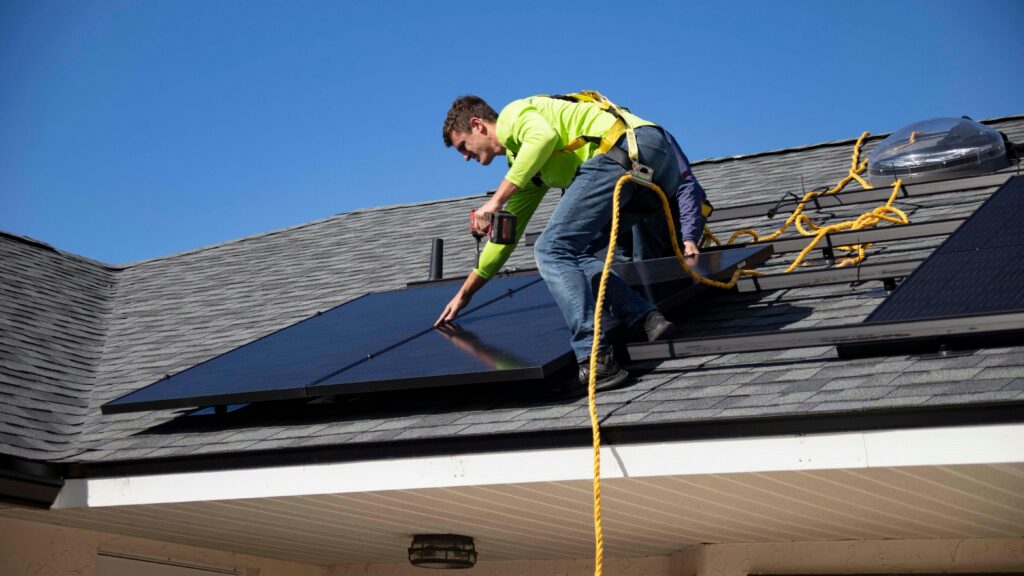
Roof-mounted systems are the most common residential installation. The panels attach to your existing roof structure using racking hardware and flashed mounting points. This approach uses space that would otherwise go unused, keeps the panels out of the way, and avoids taking up yard area.
In Southern California, most residential roofs face south or southwest, which provides excellent solar exposure. Your roof’s pitch, age, and material all influence whether a roof-mount system is practical. Before installing panels, your roof should be in good condition with at least 10 to 15 years of remaining life. At August Roofing and Solar, we evaluate your roof as part of every solar consultation because, with over 30 years of roofing experience, we understand how the two systems interact.
Ground-Mounted Solar Panels
Ground-mounted systems are anchored to the earth using posts, racks, or concrete footings. They are ideal for properties with large lots, suboptimal roof angles, or roofs that are heavily shaded. Ground-mounted arrays are also easier to access for cleaning and maintenance.
The main drawbacks are cost and space. Ground-mounted systems require trenching for wiring, a concrete foundation or driven posts, and often a permit for the ground structure itself. They also take up usable yard space. For rural or semi-rural properties in Southern California’s inland areas, ground-mount installations can be an excellent solution.
Tracking Systems
Some ground-mounted arrays include single-axis or dual-axis tracking systems. These motors rotate the panels to follow the sun throughout the day. Tracking systems can increase annual energy production by 15% to 25%, but they add mechanical complexity and maintenance requirements. They are more common in commercial installations than residential ones.
Best Solar Panels for Southern California Homes
Southern California’s climate is nearly ideal for solar energy. The region averages 270 to 300 sunny days per year, and the high UV index means panels receive strong, consistent irradiance even during shorter winter days. However, local conditions still influence which panel type and mounting approach work best.
Coastal Areas
Homes near the coast benefit from moderate temperatures year-round, which helps all panel types maintain efficiency. However, the marine layer can reduce morning production, especially in late spring and early summer. High-efficiency monocrystalline panels help offset these losses by converting a greater percentage of available light.
Salt air can also affect mounting hardware over time. Stainless steel or anodized aluminum racking is recommended for coastal installations.
Inland Valleys and Desert-Adjacent Areas
Inland homeowners deal with extreme summer heat. As noted earlier, higher temperatures reduce panel output. Monocrystalline panels with low temperature coefficients are the best solar panels for home installations in these areas. Adequate roof ventilation beneath the panels also helps, as an air gap between the panel and roof surface allows heat to dissipate.
Dust accumulation is another factor. Inland and desert-adjacent properties may need more frequent panel cleaning to maintain optimal production.
Wildfire Risk Zones
If your home is in a designated wildfire hazard zone, your solar installation must comply with CAL FIRE guidelines for setbacks and access pathways. Panels must allow firefighters to safely ventilate a roof. This can limit the number of panels you can install, making higher-efficiency monocrystalline panels even more valuable because each panel produces more power.
How to Choose the Right Type of Solar Panel for Your Home
Selecting the right panel comes down to four factors: available space, budget, energy goals, and local conditions. Here is a straightforward framework for making your decision.
Step 1: Assess Your Roof
Determine how much usable roof space you have. A qualified installer will evaluate your roof’s orientation, pitch, shading, and structural condition. If you have limited space, monocrystalline panels are the clear choice. If you have plenty of room, polycrystalline may save you money upfront.
Step 2: Define Your Energy Goals
Review your electricity bills from the past 12 months. Your system should be sized to offset most or all of your annual consumption. In Southern California, systems are typically designed to work within California’s Net Energy Metering (NEM) framework, which credits you for excess energy sent back to the grid through Southern California Edison or your local utility.
Step 3: Compare Quotes by Cost Per Watt
When comparing proposals from different installers, look at the cost per watt rather than the total system price. This normalizes the comparison across different panel types and system sizes. A system using premium monocrystalline panels may cost more per watt, but it may also fit within a smaller footprint and produce more energy over its lifetime.
Step 4: Evaluate the Installer
The quality of your installation matters as much as the panel technology. Improper mounting can void your roof warranty, cause leaks, or reduce system performance. August Roofing and Solar is both a licensed roofing contractor and a certified solar installer, which means your roof and your solar system are handled by a single team with no finger-pointing if issues arise. We also require no deposit to begin work.
Q: Should I wait for newer panel technology before going solar?
A: There is always a newer technology on the horizon, but current monocrystalline panels are highly mature and efficient. Waiting means missing out on years of energy savings and current incentive programs, which may change. The best time to install is when your roof is in good condition and your energy bills justify the investment.
California Solar Programs and Incentives to Know
California offers several programs that affect the financial return of your solar investment. Understanding these programs helps you evaluate proposals more accurately.
Net Energy Metering (NEM)
NEM allows homeowners with solar to send excess electricity to the grid and receive bill credits from their utility. The current NEM 3.0 structure, which took effect in April 2023, values exported energy at a lower rate than previous versions. This has made battery storage more attractive, as storing excess energy for evening use can be more valuable than exporting it.
Self-Generation Incentive Program (SGIP)
SGIP provides rebates for battery storage systems. Homeowners in high-fire-risk areas may qualify for enhanced incentives. A battery paired with solar allows you to maintain power during grid shutoffs, which are increasingly common during Santa Ana wind events in Southern California.
Federal Investment Tax Credit (ITC)
The federal solar tax credit currently covers 30% of the total system cost, including panels, inverters, batteries, and installation labor. This credit applies to both roof-mounted and ground-mounted systems.
Title 24 Solar Mandate
Since 2020, California’s Title 24 building code requires solar panels on most new residential construction. If you are building a new home, your builder is required to include solar as part of the project. Understanding the types of solar panels helps you ensure your builder is not defaulting to the cheapest option when a more efficient panel would better serve your energy needs.
People Also Ask
What are the 3 main types of solar panels?
The three main types of solar panels are monocrystalline, polycrystalline, and thin-film. Monocrystalline panels are the most efficient and most commonly used in residential installations. Polycrystalline panels offer a lower-cost alternative, while thin-film panels are primarily used in commercial and utility-scale projects.
Which type of solar panel is best for a house?
Monocrystalline solar panels are generally the best solar panels for home use. They provide the highest efficiency, perform well in high heat, and require less roof space to generate the same amount of electricity as other panel types.
How long do solar panels last?
Most solar panels carry a 25-year performance warranty and can continue producing electricity for 30 years or more. Degradation rates for modern monocrystalline panels are typically 0.3% to 0.5% per year, meaning they still produce 85% or more of their original output after 25 years.
Do solar panels work on cloudy days in Southern California?
Yes. Solar panels generate electricity from light, not direct sunlight alone. On cloudy or overcast days, panels still produce energy, though at reduced levels. Coastal areas that experience frequent marine layer mornings may see temporarily lower morning output, but annual production in Southern California remains among the highest in the country.
Frequently Asked Questions
What types of solar panels are best for Southern California homeowners?
Monocrystalline solar panels are the best choice for most Southern California homes. Their high efficiency allows homeowners to generate more power in limited roof space, and their lower temperature coefficient helps maintain output during the region’s hot summers. They are the most widely installed residential panel type in the area.
How do I know which types of solar panels fit my roof?
A qualified solar installer will assess your roof’s size, orientation, pitch, shading, and structural condition. Homes with limited south-facing space benefit most from high-efficiency monocrystalline panels. Properties with larger, unobstructed roofs may find that polycrystalline panels offer adequate performance at a lower cost.
Can I mix different types of solar panels on one system?
Technically, yes, but it is not recommended. Mixing panel types can create electrical mismatches that reduce overall system performance. Each panel type has different voltage and current characteristics, and combining them complicates inverter selection and system design. A uniform array is simpler, more efficient, and easier to maintain.
How do types of solar panels affect my electricity bill savings?
Higher-efficiency panels produce more electricity per square foot, which means greater bill offset. Under California’s NEM 3.0, maximizing self-consumption is especially important. Pairing efficient panels with a battery allows you to store daytime production for evening use, reducing the amount of energy you need to buy from Southern California Edison during peak-rate hours.
Does August Roofing and Solar help with panel selection?
Yes. August Roofing and Solar provides a comprehensive evaluation of your roof and energy needs before recommending a specific panel type. With over 30 years of experience in both roofing and solar installation, the team ensures your panel choice, mounting system, and roof condition all work together for long-term performance. There is no deposit required to get started.
Ready to Find the Right Solar Panels for Your Home?
Understanding the types of solar panels is the first step toward a system that performs well and delivers real savings. Whether your home sits along the coast or in an inland valley, the right panel technology matched to your roof and energy goals makes all the difference.
If you would like a professional evaluation of your roof and a clear recommendation on the best solar panels for your home, contact August Roofing and Solar or call (805) 519-8099 to schedule a free consultation. We are happy to walk you through your options with no pressure and no deposit required.