
Key Takeaways
- The best solar panels for Southern California homes prioritize high efficiency ratings (20% or above), strong warranty coverage (25 years), and proven performance under intense UV exposure and heat.
- Solar panel efficiency matters more in Southern California than in cooler climates because panels lose output as temperatures rise, making high-temperature-coefficient panels a smarter long-term investment.
- SunPower Maxeon panels currently lead the residential market in efficiency and durability, which is why August Roofing & Solar partners with them as a certified dealer.
- California’s NEM 3.0 net metering policy makes battery pairing and self-consumption more important than ever, so choosing panels that integrate well with storage systems is critical.
- Total cost of ownership, not just sticker price, determines real value. Higher-efficiency panels generate more electricity per square foot over 25 years, often offsetting a higher upfront cost.
Quick Links
- Why Choosing the Right Solar Panels Matters
- How Solar Panels Work at a System Level
- Key Factors When Choosing the Best Solar Panels for Southern California
- Types of Solar Panels Compared
- Best Solar Panels for Southern California Homes
- NEM 3.0 and Why Battery Pairing Matters
- Cost, Financing, and Long-Term Value
- Roof and Installation Considerations
- People Also Ask
- Frequently Asked Questions
Why Choosing the Right Solar Panels Matters Before You Invest
You have spent weeks researching solar, gotten a few quotes, and now every company is telling you something different about which panels are “the best.” One installer pushes the cheapest option, another talks about brands you have never heard of, and you are left wondering whether the price difference actually translates to real-world performance on your roof.
The truth is that choosing the best solar panels for Southern California involves more than comparing wattage numbers on a spec sheet. Our region’s high UV index, temperature swings between coastal and inland zones, and evolving utility policies like NEM 3.0 all influence which panel technology will deliver the most value over a 25-year lifespan. A panel that performs well in Oregon may underperform here.
This guide breaks down how solar panels work, what specifications actually matter, and which products consistently perform best under Southern California conditions. The goal is to give you the knowledge to evaluate any quote with confidence.
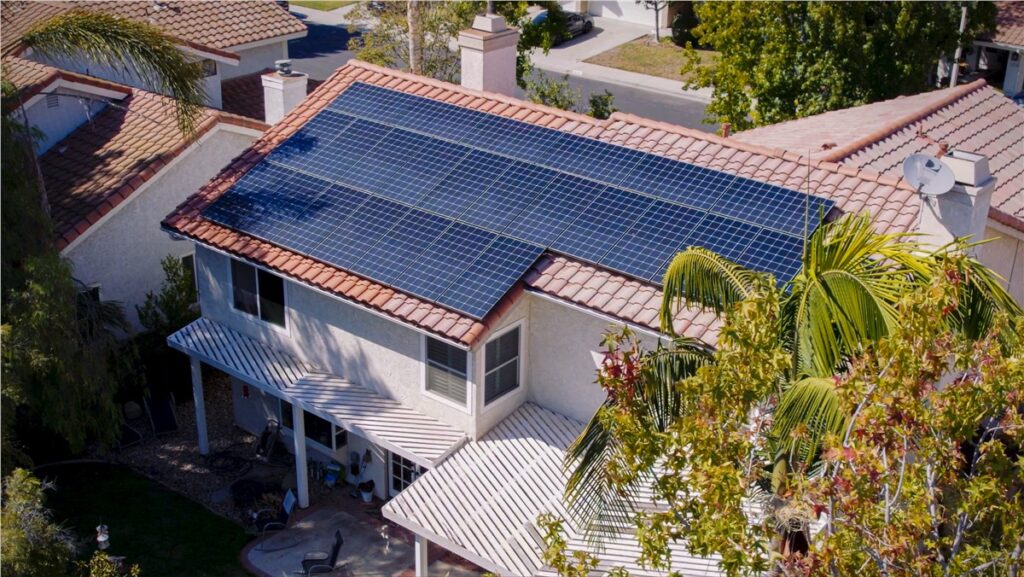
How Solar Panels Work at a System Level
A residential solar system is not just panels on a roof. It is an interconnected system with several components working together to convert sunlight into usable electricity for your home.
The Core Components
Solar panels contain photovoltaic (PV) cells, typically made from silicon wafers. When photons from sunlight strike the silicon, they knock electrons loose, creating a flow of direct current (DC) electricity. This is the photoelectric effect, first described by Einstein in 1905.
That DC electricity flows through wiring to an inverter, a device that converts it into alternating current (AC), which is the type of electricity your home appliances use. Most modern residential systems use either a string inverter (one central unit) or microinverters (small units attached behind each panel).
From the inverter, AC power feeds into your home’s electrical panel. Any excess electricity either flows to the utility grid (earning you credits under net metering) or charges a home battery system if one is installed.
Why This Matters for Panel Selection
Understanding this system helps you evaluate panels more clearly. A panel with higher solar panel efficiency converts more sunlight per square foot, meaning you may need fewer panels to meet your energy needs. In Southern California, where roof space sometimes competes with vents, skylights, or complex roof geometry, efficiency per panel is a practical consideration, not just a marketing number.
Q: Do I need microinverters or a string inverter?
A: Microinverters are generally preferred for Southern California homes because they optimize each panel independently. If one panel is shaded by a chimney or tree during part of the day, the other panels continue producing at full capacity. String inverters reduce the entire system’s output to match the weakest panel.
Key Factors When Choosing the Best Solar Panels for Southern California
Not every solar panel performs equally under Southern California’s specific climate conditions. Here are the factors that matter most when evaluating your options.
Efficiency Rating
Solar panel efficiency measures what percentage of sunlight hitting the panel gets converted into electricity. Standard panels range from 17% to 22.8%. In a region with over 280 sunny days per year, even a 2% efficiency difference compounds significantly over 25 years.
Higher efficiency also means fewer panels needed. If your roof has limited south-facing space, a 22% efficient panel will generate roughly 25% more power than an 18% panel of the same physical size.
Temperature Coefficient
This is where Southern California’s climate becomes especially relevant. All solar panels lose efficiency as they heat up. The temperature coefficient, measured in percentage loss per degree Celsius above 25 degrees C (77 degrees F), tells you how much.
Inland areas of Southern California regularly see roof surface temperatures exceeding 65 degrees C (149 degrees F) during summer. A panel with a temperature coefficient of -0.27% per degree C will retain significantly more output than one rated at -0.40% per degree C. Over a full summer, this difference adds up.
Degradation Rate
All solar panels slowly lose output capacity over time. This is called degradation. Industry-standard panels degrade at about 0.5% to 0.7% per year. Premium panels degrade at 0.25% per year or less. After 25 years, a panel degrading at 0.25% annually still produces about 93.75% of its original output. A panel degrading at 0.7% annually produces only about 83%.
Warranty Coverage
A strong warranty protects your investment. Look for warranties that cover three things: product defects (the hardware itself), performance guarantees (minimum output at 25 years), and labor costs for any warranty-related service. Some manufacturers cover all three. Others cover only the panel hardware, leaving you responsible for labor and removal costs.
Q: What is a good warranty length for solar panels?
A: The industry standard for premium residential panels is 25 years of combined product and performance coverage. Some manufacturers now offer 30-year or even 40-year warranties. Always confirm whether labor is included.
Types of Solar Panels Compared
There are three main types of solar panels available for residential installations. Each uses a different cell technology with distinct advantages and trade-offs.
Monocrystalline Panels
Monocrystalline panels are made from single-crystal silicon wafers. They offer the highest efficiency ratings (19% to 22.8%), the best heat tolerance, and the sleekest appearance with uniform black cells. They cost more per panel but produce more electricity per square foot.
For most Southern California homes, monocrystalline panels represent the best balance of performance, aesthetics, and long-term value.
Polycrystalline Panels
Polycrystalline panels use multi-crystal silicon, which is less expensive to manufacture. They typically achieve 15% to 18% efficiency and have a blue, speckled appearance. While adequate for large roof areas where space is not a concern, they produce less power per panel and have higher temperature coefficients, making them less suited to hot inland climates.
Thin-Film Panels
Thin-film panels are lightweight and flexible, but their efficiency ranges from only 10% to 13%. They are rarely used in residential applications because they require significantly more roof space to match the output of crystalline panels. They are more common in large commercial installations.
- Best for most Southern California homes: Monocrystalline (highest efficiency, best heat performance)
- Budget option for large roofs: Polycrystalline (lower cost, lower efficiency)
- Specialized use only: Thin-film (commercial, carports, non-standard surfaces)
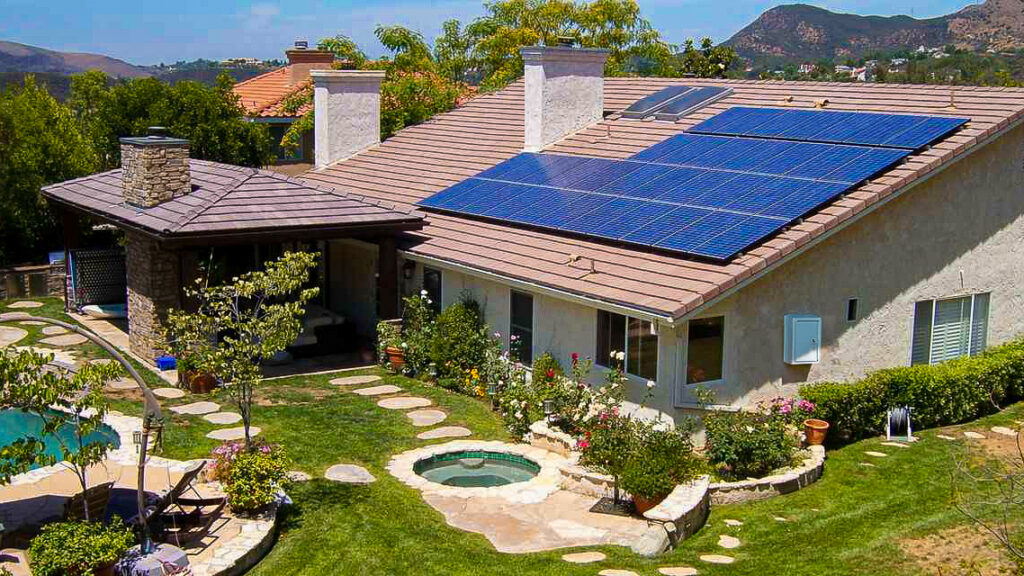
Best Solar Panels for Southern California Homes
Based on efficiency, temperature performance, degradation rates, warranty coverage, and real-world track record in hot climates, here are the top panel options for Southern California homeowners.
SunPower Maxeon Series
SunPower Maxeon panels hold the residential efficiency record at 22.8%. Their patented Maxeon cell design uses a solid copper foundation instead of thin metal ribbons, which virtually eliminates the cracking and corrosion that cause most panel failures. Key specifications include:
- Efficiency: up to 22.8%
- Temperature coefficient: -0.27% per degree C
- Degradation rate: 0.25% per year
- Warranty: 40 years (product, performance, and labor)
SunPower has manufactured solar panels since 1985 and currently operates in over 100 countries. August Roofing & Solar is a certified SunPower dealer, which means installations are backed by both the manufacturer warranty and our own 30-plus years of roofing and solar experience.
REC Alpha Pure-R Series
REC panels use heterojunction (HJT) cell technology, which pairs well with Southern California heat. They offer strong efficiency and excellent temperature performance at a slightly lower price point than SunPower.
- Efficiency: up to 22.3%
- Temperature coefficient: -0.24% per degree C
- Degradation rate: 0.25% per year
- Warranty: 25 years (product and performance)
Panasonic EverVolt H Series
Panasonic’s EverVolt panels combine high efficiency with seamless battery integration. They are designed to work within a complete Panasonic energy ecosystem, which can simplify system design.
- Efficiency: up to 22.2%
- Temperature coefficient: -0.26% per degree C
- Degradation rate: 0.26% per year
- Warranty: 25 years (product, performance, and labor)
Q Cells Q.PEAK DUO
Q Cells offer solid performance at a mid-range price, making them a reasonable option for homeowners prioritizing budget over peak efficiency.
- Efficiency: up to 20.6%
- Temperature coefficient: -0.34% per degree C
- Degradation rate: 0.54% per year
- Warranty: 25 years (product and performance)
Q: Why does August Roofing & Solar recommend SunPower?
A: We selected SunPower after evaluating multiple manufacturers because their Maxeon cell technology consistently outperforms competitors in high-heat, high-UV environments like Southern California. Their 40-year warranty and low degradation rate align with our approach of installing systems that last, not systems that need replacing. Learn more on our SunPower partnership page.
NEM 3.0 and Why Battery Pairing Matters
California’s Net Energy Metering 3.0 policy, which took effect in April 2023, fundamentally changed the economics of residential solar. Under NEM 3.0, the credits you receive for exporting excess electricity to the grid are significantly lower than under the previous NEM 2.0 policy, sometimes reduced by 75% or more.
This shift means that solar panel efficiency and self-consumption are now more important than ever. The goal is no longer simply to produce as much electricity as possible and sell the surplus. Instead, the goal is to produce electricity when you need it and store what you cannot use immediately.
How Battery Storage Fits In
A home battery system, such as the systems August Roofing & Solar installs, stores excess solar energy produced during the day so you can use it during evening peak-rate hours when Southern California Edison charges the highest rates. This strategy, called load shifting, maximizes the financial return of your solar investment under NEM 3.0.
Additionally, California’s Self-Generation Incentive Program (SGIP) provides rebates that can offset 10% to 25% of battery installation costs, with higher rebates available in wildfire-prone areas. Given that much of Southern California falls within CAL FIRE’s fire hazard severity zones, many homeowners qualify for enhanced incentives.
Q: Is a battery required under NEM 3.0?
A: A battery is not technically required, but without one, your system’s financial payback period extends significantly. Under NEM 3.0, pairing solar with storage typically reduces the payback period by 3 to 5 years compared to solar-only systems, according to the California Public Utilities Commission (CPUC).
Cost, Financing, and Long-Term Value
The average cost of a residential solar system in Southern California ranges from $2.50 to $3.50 per watt before incentives, depending on panel brand, system size, and installation complexity. For a typical 8 kW system, that translates to $20,000 to $28,000 before the federal Investment Tax Credit (ITC).
The federal ITC currently provides a 30% tax credit on the total cost of a solar installation, including batteries. This reduces an $24,000 system to a net cost of approximately $16,800.
Total Cost of Ownership vs. Sticker Price
Choosing the cheapest panels does not always save money over time. A panel with 18% efficiency and 0.6% annual degradation will produce roughly 15% less total electricity over 25 years than a 22% efficient panel with 0.25% degradation. That difference often exceeds the higher upfront cost of premium panels.
Here is a simplified comparison for an 8 kW system in Southern California:
- Budget panels (18% efficiency, 0.6% degradation): Estimated 25-year production of approximately 245,000 kWh
- Premium panels (22.8% efficiency, 0.25% degradation): Estimated 25-year production of approximately 295,000 kWh
- Difference: Approximately 50,000 kWh, worth $12,000 to $17,000 at current Southern California Edison rates
Financing Options
Most solar installations offer financing with no money down. At August Roofing & Solar, we require no deposit to begin a project. Common financing options include solar loans (fixed-rate, 10 to 25 year terms), home equity lines of credit, and manufacturer financing programs.
We recommend avoiding solar leases and power purchase agreements (PPAs) when possible, as they transfer the financial benefits (including the tax credit and increased home value) to the leasing company rather than the homeowner. Learn more about our solar maintenance and long-term care approach.
Roof and Installation Considerations for Southern California
Your roof’s condition, material, and orientation all affect which solar panels are the best fit and how much electricity your system will produce.
Roof Condition
Solar panels are designed to last 25 to 40 years. If your roof has fewer than 10 years of remaining life, it usually makes more sense to replace the roof before or during the solar installation. Removing and reinstalling solar panels for a future roof replacement adds $2,000 to $5,000 in labor costs.
August Roofing & Solar handles both roofing and solar under one contract, which simplifies the process and eliminates the coordination challenges of hiring two separate companies.
Roof Material Compatibility
Composite shingle and standing-seam metal roofs are the easiest to work with for solar mounting. Tile roofs, common throughout Southern California, require specialized tile hooks and careful flashing to prevent leaks. Flat roofs use ballasted or tilt-up racking systems to achieve optimal panel angles.
Orientation and Tilt
South-facing roof planes produce the most annual electricity in the Northern Hemisphere. West-facing planes produce peak output during afternoon hours, which aligns well with NEM 3.0’s time-of-use rate structure. East-facing planes produce morning energy. North-facing planes are generally unsuitable for solar in Southern California.
The optimal tilt angle for solar panels in Southern California is typically between 20 and 30 degrees, which conveniently matches the pitch of most residential roofs in the region.
Permitting and Interconnection
All residential solar installations in California require a building permit and interconnection agreement with the local utility, typically Southern California Edison for most of the region. California’s Title 24 energy code also requires new homes to include solar, and many jurisdictions apply similar standards to major roof replacements.
A qualified installer handles all permitting and interconnection paperwork. At August Roofing & Solar, this is included in every project at no additional cost.
People Also Ask
What is the most efficient solar panel for home use?
SunPower Maxeon panels hold the highest residential efficiency rating at 22.8%. Their patented cell technology and low degradation rate make them the top-performing option for home use, particularly in high-heat climates like Southern California.
How many solar panels do I need for my house in Southern California?
Most Southern California homes require 16 to 24 panels for a typical 8 kW to 10 kW system, depending on panel efficiency and household energy consumption. Homes with electric vehicles, pools, or HVAC systems running frequently may need more.
Are solar panels worth it in California in 2025?
Yes. Despite NEM 3.0 reducing grid export credits, the combination of high electricity rates from Southern California Edison, the 30% federal tax credit, and battery storage incentives makes solar a strong financial decision. Most systems achieve payback within 6 to 9 years.
Do solar panels work on cloudy days in Southern California?
Solar panels still produce electricity on cloudy days, though at reduced output (typically 10% to 25% of full capacity). Southern California’s coastal marine layer usually burns off by midday, and the region averages over 280 sunny days per year, making annual production consistently high.
Frequently Asked Questions
What are the best solar panels for Southern California homes?
The best solar panels for Southern California homes are high-efficiency monocrystalline panels with low temperature coefficients and strong warranty coverage. SunPower Maxeon panels currently lead in efficiency (22.8%), degradation resistance (0.25% per year), and warranty length (40 years), making them the top recommendation for this region’s climate.
How does heat affect solar panel efficiency in Southern California?
All solar panels lose efficiency as temperatures rise above 25 degrees C (77 degrees F). The temperature coefficient, expressed as a percentage loss per degree, determines how much output drops. In inland Southern California, where roof temperatures can exceed 65 degrees C, choosing panels with a low temperature coefficient (below -0.30%) preserves significantly more energy production.
Should I pair solar panels with a battery under NEM 3.0?
Pairing solar panels with battery storage is strongly recommended under California’s NEM 3.0 policy. Without a battery, excess daytime energy is exported to the grid at low credit rates. A battery stores that energy for use during expensive peak evening hours, improving your system’s financial return and reducing your payback period by 3 to 5 years.
How do I choose the best solar panels for Southern California if I have limited roof space?
If your roof has limited south-facing or west-facing area, prioritize solar panel efficiency above all other factors. Higher-efficiency panels (21% and above) generate more electricity per square foot, allowing a smaller number of panels to meet your energy needs. This is especially important for homes with complex roof geometry, skylights, or venting equipment.
What warranty should I look for when choosing the best solar panels for Southern California?
Look for a combined product and performance warranty of at least 25 years that includes labor coverage. The strongest warranties in the industry, such as SunPower’s 40-year complete warranty, cover panel replacement, performance guarantees, and all associated labor costs. Always confirm warranty terms in writing before signing a contract.
Choose Your Solar Panels with Confidence
Selecting the best solar panels for Southern California comes down to matching your roof, your energy needs, and your budget with a panel technology proven to perform in this region’s demanding climate. High efficiency, low degradation, and strong warranty coverage are the three pillars of a system that delivers value for decades.
If you are ready to explore your options, reach out to August Roofing & Solar to schedule a free, no-obligation consultation. As a licensed and certified SunPower dealer with over 30 years of roofing and solar experience, we can evaluate your roof, design a system tailored to your home, and walk you through every detail, from panel selection to permitting. No deposit is required to get started. Call us at (805) 519-8099 or fill out our online form to request your free quote.